

Quick Answer
To improve your blog readability score, keep average sentence length under 20 words, swap three-syllable words for short ones, and write in active voice. Aim for 60–70 on the Flesch Reading Ease scale. In my test, one paragraph jumped from −12 to 79 without losing a fact.
Before writing this guide, I scored the 11 top-ranking articles on this exact topic. Only three of them hit the 60–70 target they tell you to aim for. The rest landed between 53 and 59.
That result shaped everything below. Most advice on how to improve blog readability score repeats the same eight tips and never proves they work. You get my own before-and-after test, the scores of the pages that rank, the trap that makes scores lie, and a free readability checker to use while you edit.
What is a good readability score for a blog post?
A good readability score for most blogs is 60–70 on the Flesch Reading Ease scale, which matches a US grade 8–9 reading level. Microsoft gives the same range in its guide to Word’s readability statistics, and suggests a Flesch–Kincaid grade of about 7 to 8 for most documents.
Flesch Reading Ease uses just two inputs: average words per sentence and average syllables per word. Higher scores mean easier text. The Flesch–Kincaid grade level turns the same inputs into a school grade, where lower is easier.

Your target depends on who reads you:
- General blogs, how-to guides, product pages: 60–70 (grade 8–9)
- B2B, SaaS and technical tutorials: 50–60 works, because readers expect terms like “API” or “canonical tag”
- Beginners or readers with English as a second language: 70+ (grade 7 or lower)
Hemingway Editor notes that over half of US adults read at an 8th-grade level. Write above that level and you shrink your audience before the second paragraph.
How do you improve your blog readability score step by step?
Edit in five passes, in this order, and rescore after passes 3 and 5. The order matters: splitting sentences first often removes hard words along the way, so you swap fewer of them later.

Pass 1: Score the draft and find the red sentences
Paste the whole post into a checker and note three numbers: Flesch score, grade level and the share of sentences over 20 words. That last number tells you the most. When I scored the top-ranking articles (results below), Readable’s guide passed 60 overall yet had 20% of its sentences over 20 words. A good average can hide a handful of monsters.
Pass 2: Split every sentence over 30 words
Look for the natural break points: “and”, “which”, “while”, “because” and any second comma. Each one usually hides a second idea. The opening sentence in my before-and-after test (below) had 36 words and three ideas. It became two sentences.
Don’t chop everything into five-word lines, though. Mix short sentences with medium ones of 15–20 words so the text keeps a natural rhythm. My guide on how to humanize AI content covers why that variety matters for AI drafts.
Pass 3: Swap long words for short ones
Every three-syllable word pulls your score down. These swaps come up in almost every draft I edit:
| Instead of | Write |
| utilise | use |
| approximately | about |
| demonstrate | show |
| facilitate | help |
| in order to | to |
| consequently | so |
| a wide variety of | many |
| is able to | can |
Keep a technical term when your reader needs it. “Schema markup” stayed in my rewrite because SEO readers search for that phrase. Explain it once, then move on.
Pass 4: Switch passive sentences to active
Passive voice hides who does what: “the content that is being published” becomes “the content you publish”. Yoast and AIOSEO both flag passive voice once it passes 10% of sentences. The original paragraph in my test sat at 25%.
While you are in each sentence, write to one reader. “You” and “I” read faster than “users” and “the organisation”, and they turn a lecture into a conversation.
Pass 5: Read it aloud and fix where you stumble
Formulas can’t hear. If you run out of breath or lose your place, rewrite the sentence, whatever the score says. This pass also catches over-simplified lines, a problem covered further down.
Then fix the layout for skimmers and phones
Layout doesn’t change your Flesch score, but it decides whether the 79% who scan find what they came for:
- Paragraphs of 2–4 sentences. A four-line paragraph on a laptop can fill a whole phone screen.
- A descriptive subheading every 250–300 words. Write it as a question or an answer, not a label like “Overview”.
- Lists for three or more parallel items, and bold for the one phrase a skimmer must not miss.
- Transition words such as “so”, “but”, “because” and “for example”. Yoast turns its check green when at least 30% of sentences contain one. They link ideas so short sentences don’t feel choppy.
- A table, image or screenshot wherever you’d otherwise describe numbers in a paragraph.
What happened when I rewrote one paragraph for readability?
I took a paragraph in the style I see in most raw AI drafts and unedited agency copy: long, abstract and full of filler. I scored it in our checker, edited it in five passes, and scored it again.

Before (Flesch −12, shown as 0 in the tool):
“Search engine optimisation is a multifaceted discipline that requires marketers to carefully consider a wide variety of interconnected factors, including keyword research, technical website performance, and the overall quality of the content that is being published. In order to achieve sustainable organic growth, it is essential that businesses develop a comprehensive understanding of how search algorithms evaluate relevance and authority…”
After (Flesch 79):
“Good SEO needs three things to work together: the right keywords, a fast and healthy website, and content people want to read. Once you know how Google judges whether a page is useful and trusted, you can plan for growth that lasts. Schema markup helps search engines understand each page…”
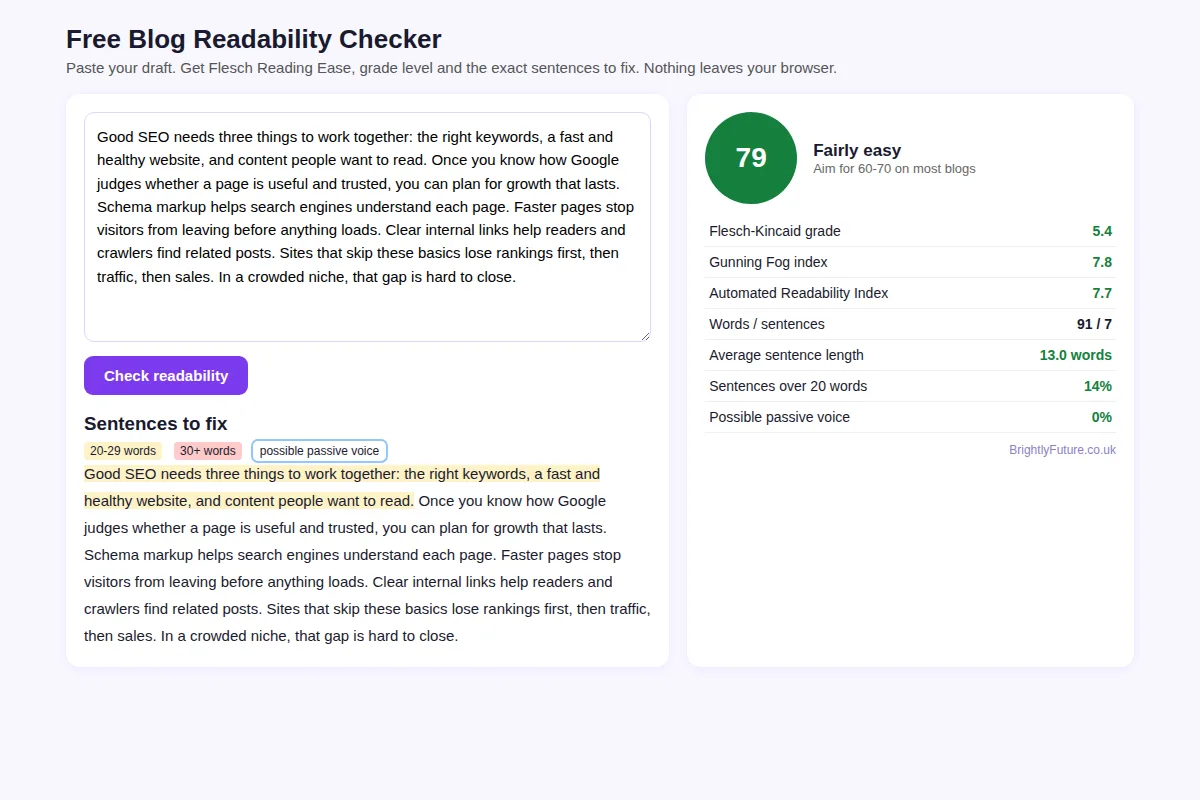
| Metric | Before | After |
| Flesch Reading Ease | −12.1 | 79.3 |
| Flesch–Kincaid grade | 22.6 | 5.4 |
| Gunning Fog index | 28.9 | 7.8 |
| Average sentence length | 30.8 words | 13.0 words |
| Average syllables per word | 2.22 | 1.35 |
| Sentences over 20 words | 100% | 14% |
| Possible passive voice | 25% | 0% |
| Word count | 123 | 91 |
Two results surprised me. First, I cut 32 words and lost nothing. Keywords, site health, content quality, how Google judges trust, schema, page speed, internal links and the cost of skipping them all survived the rewrite.
Second, word choice mattered more than I expected. When I ran the Flesch–Kincaid maths on the 17-grade drop, about 10 grades came from shorter words and about 7 from shorter sentences. Splitting sentences is the fastest fix, but swapping words like “multifaceted” and “comprehensive” did the heavier lifting.
Can you get a readability score that is too high?
Yes. A score above 85 on an informational post usually means you cut detail, not clutter. Readability formulas only count sentence length and syllables, so choppy fragments score brilliantly while reading badly.
I proved it with the same paragraph. I chopped it into 16 fragments like “SEO is big. It has parts. Keywords count.” The checker gave it a perfect 100.

That version tells the reader nothing. It dropped from 91 words to 35 and lost every explanation of why each factor matters. Yoast cited the same weakness when it replaced the Flesch score in its readability analysis in version 19.3: the score “only looks at sentence and word length, ignoring context, tone, and audience.”
My rule: once you land in 60–70, stop editing for the number and edit for meaning.
Can AI tools improve your readability score?
Yes, if you give them strict rules and check the result. Claude and ChatGPT can split sentences and swap long words in seconds. The risk is that they cut facts to reach an easy score, which is the trap described above.
Try a prompt like this:
“Rewrite the text below for a Flesch Reading Ease of 60–70. Keep every fact, number and name. Keep these terms unchanged: [your keywords and technical terms]. Use active voice. Keep average sentence length at 14–18 words and vary it. Don’t add new claims. After the rewrite, list any fact you removed.”
The last line is your safety net. Then paste the output into the checker and compare it with your original, sentence by sentence. If you work in WordPress, AIOSEO also has a built-in AI assistant for readability edits.
Does readability score affect Google rankings?
No. Readability score is not a direct Google ranking factor. Google’s John Mueller said in a 2018 Webmaster Hangout that Google does not run basic algorithms that count words and syllables to judge pages.
The data agrees. Portent analysed 756,297 pieces of content across 30,000 search queries and found no link between reading level and ranking position. The mean Flesch score of the top 30 results sat between 51.8 and 53.1. Originality.ai reached the same conclusion in a study of 13,582 top-20 results across 1,000 keywords: ranking pages have similar readability, but the score does not predict position.
So why bother? Because readers decide whether your page did its job, and that shows up in how they behave.
- Readers scan first. Nielsen Norman Group found that 79% of users scan web pages and only 16% read word by word. In the same research, a version rewritten to be concise, scannable and objective scored 124% higher on usability.
- Readability tracks with sales. Portent’s study of 33 client websites found readability explained around 11% of the variation in conversion rate, rising to about 13% for e-commerce. For B2B sites the link was not significant.
Treat the score as a diagnostic, not something Google grades. It points you to the sentences that make people leave.
What do the top-ranking readability articles score?
I scored the main body text of 11 ranking guides for “how to improve readability score” in September 2026. Only three reached 60. The median was 55.7, a “fairly difficult” rating.

| Article | Words | Flesch | FK grade | Avg sentence |
| The Engage (Substack) | 2,063 | 66.7 | 7.2 | 13.1 |
| AIOSEO | 1,987 | 65.8 | 6.8 | 11.0 |
| Readable | 1,474 | 61.2 | 8.4 | 14.7 |
| StoryChief | 1,056 | 59.3 | 8.0 | 12.1 |
| Ranked.ai | 1,196 | 57.5 | 8.7 | 13.7 |
| LowFruits | 2,021 | 55.7 | 8.1 | 10.7 |
| Hemingway | 1,235 | 55.7 | 8.5 | 12.1 |
| Grammarist | 2,014 | 54.9 | 8.3 | 11.1 |
| Wordtune | 1,775 | 54.5 | 8.4 | 11.1 |
| Social Media Strategies Summit | 1,914 | 54.2 | 9.0 | 13.4 |
| StanzaGo | 3,362 | 53.5 | 9.1 | 13.4 |
Two lessons came out of this. First, pages rank comfortably at 53–59, which fits Portent’s finding that ranking pages cluster in the low 50s. You don’t need a perfect score to rank.
Second, most of these articles already had short sentences, averaging 10–14 words, and still scored in the 50s. The drag came from vocabulary. Words like “readability”, “optimisation” and “comprehension” carry four or five syllables each. On a topic full of long terms, 55–60 is a realistic ceiling, and that’s fine.
A note on method: I scored text extracted from each page’s main content with our own checker. Tools count syllables differently, so Hemingway, Yoast or Readable may show a few points higher or lower. Compare scores from the same tool, never across tools.
Which free tools check blog readability?
The best free readability checker depends on where you write. Each of these suits a different stage:
- BrightlyFuture Readability Checker – free, no sign-up. Shows Flesch, Flesch–Kincaid, Gunning Fog and ARI side by side, and highlights sentences over 20 and 30 words plus likely passive voice. Best for pass 1 and the final rescore.
- Hemingway Editor – the free web version colour-codes hard sentences, adverbs and passive voice. Best for passes 2 and 4.
- Microsoft Word – shows Flesch Reading Ease and Flesch–Kincaid grade under Editor > Document stats in Microsoft 365. Handy if you draft in Word.
- Yoast SEO, Rank Math or AIOSEO (WordPress) – check sentence length, paragraph length, passive voice, transition words and subheading spacing inside the editor. A useful last check before publishing.
Whichever you pick, stick with one. Switching tools mid-edit makes your progress look random.
Frequently Asked Questions
What does a reading grade level mean outside the US?
Add five to the US grade to get the reader’s age. Grade 8 means roughly age 13–14, which is Year 9 in England and Wales or the second year of secondary school in many other systems. So a 60–70 Flesch score suits a typical 13–15-year-old reader.
What is a good Gunning Fog score for a blog?
Keep it below 12. The Gunning Fog index counts words of three or more syllables, and texts for a wide audience generally need a fog index under 12, with under 8 for near-universal understanding.
Do headings and bullet points affect the Flesch score?
Yes. Many checkers, including ours, treat each heading or bullet as a short sentence, which pushes the score up. Paste body text only if you want a fair baseline.
Does readability matter for AI search engines like ChatGPT and Perplexity?
Clear, self-contained sentences are easier for AI engines to quote. A direct one-sentence answer under each question-style heading gives Google AI Overviews, ChatGPT and Perplexity a clean passage to cite. No public study yet measures this with Flesch scores, so treat it as good practice rather than a proven factor.
Which old posts should I fix for readability first?
Start with posts that already get impressions in Google Search Console but show short engagement time in GA4. People find them and leave early, so clearer writing has the most room to help.
Does the BrightlyFuture checker save the text I paste?
No. The checker runs entirely in your browser with JavaScript. Your draft is never uploaded or stored, so it’s safe for unpublished client work.
Use the score as a guide, not a goal
Readability scores reward short sentences and short words, and readers do too, up to a point. Use the score to find the sentences that lose people, fix them in five passes, and let meaning win once you’re in range.
Drafting with AI? My guide on how to write a blog post using AI covers the drafting side, and the blog post word count guide covers how long the finished post should be.
For the bigger picture on tools, SEO and Google’s rules, start with our complete guide to AI content writing.