
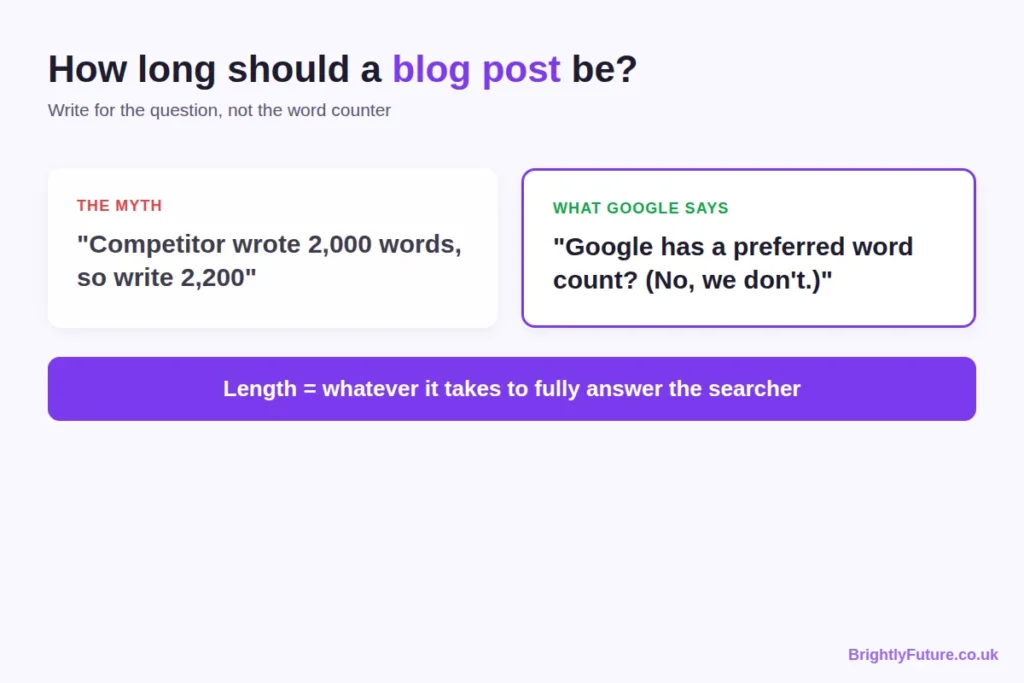
There’s no ideal word count. Google says it has no preferred length, and word count isn’t a ranking factor. A post should be as long as it takes to fully answer the searcher’s question. For reference, the average first-page result is about 1,447 words (Backlinko), but short posts that answer faster often outrank longer ones.
“Your competitor wrote 2,000 words, so write 2,200 and you’ll outrank them.” I hear this advice constantly, and it’s wrong. I’ve seen it fail in practice and I’ve seen the opposite work: across the topics I research, 800–1,000 word pages regularly rank above 2,000-word guides because they answer the question faster and better.
What decides the ranking is whether the reader’s problem is solved when they finish reading. A 1,000-word article that does that will beat a 1,500-word article that makes them dig for the answer.
This guide shows what the data and Google actually say about length, and a simple way to work out the right length for any post.
Is word count a Google ranking factor?
No. Google’s own guide to creating helpful content asks: “Are you writing to a particular word count because you’ve heard or read that Google has a preferred word count? (No, we don’t.)”
Google’s John Mueller has said the same directly: “the number of words on a page is not a quality factor, not a ranking factor”.
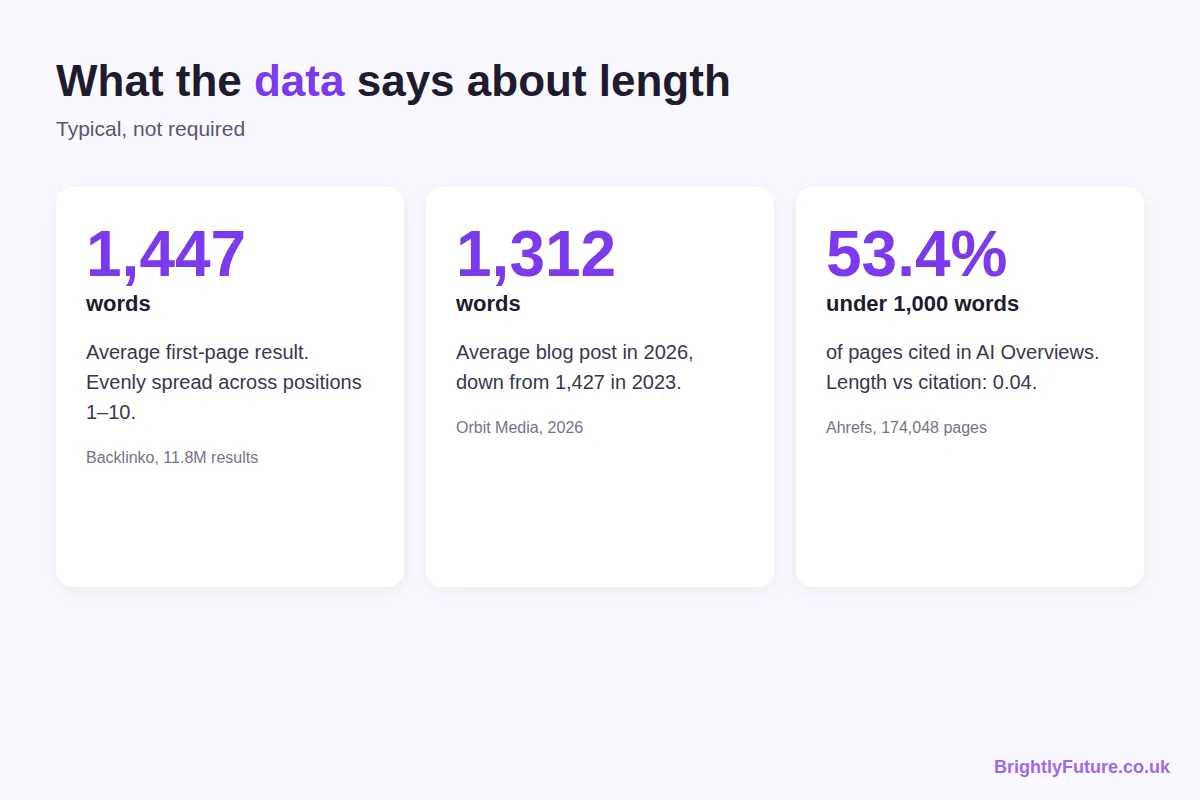
The ranking data agrees. When Backlinko analysed 11.8 million Google results, it found that word count was evenly distributed across the top 10 positions. Position 1 wasn’t longer than position 10.
Why do longer posts seem to rank better?
Because length often comes with the things that do help, not because Google counts words. A longer post is more likely to:
- cover several related questions, so it matches more searches
- include original data, examples and steps that earn links
- keep the reader from going back to Google for missing details
All of those can be achieved in fewer words. And length works against you when it’s padding: the reader has to scroll past repeated points and a slow introduction to find the answer, and many simply leave.
The practical rule: match the depth of the top results, not their word count.
What do the studies say about blog post length?
They describe what’s typical, not what’s required.
| Study | Finding | What it means for you |
| Backlinko, 11.8M results | Average first-page result: 1,447 words, evenly distributed across positions 1–10 | Length doesn’t separate position 1 from position 10 |
| Orbit Media, 2026 blogger survey | Average post: 1,312 words, down from 1,427 in 2023. Bloggers who spent 6+ hours on 2,000-word posts were roughly twice as likely to report strong results | The effort behind a long post matters, not the length alone |
| Ahrefs, 174,048 pages cited in AI Overviews | 53.4% of cited pages were under 1,000 words; correlation between length and citation: 0.04 | Length has almost no effect on AI citations |
Read the Orbit finding carefully. It links strong results to the time spent on long posts: research, original data and editing. A 2,000-word post written in an hour doesn’t get the same benefit.
How do you find the right length for your post?
Let the search results and the reader’s question set the length. This is the process I use before writing anything:
1. Search your keyword and open the top five results.
2. Identify the intent. Does the searcher want a quick answer, a step-by-step guide, a comparison or a deep overview?
3. List the questions the top results answer, plus the “People Also Ask” questions for the keyword.
4. Find the gaps: what none of them answer, or answer badly.
5. Write until every question is answered, including the gaps.
6. Cut anything that repeats a point or doesn’t help the reader act.
The word count is whatever you end up with. Check it against the top results only as a sanity check: if they’re all around 2,000 words and you finish at 600, you’ve probably missed questions the searcher has. If you’re far longer than all of them, look for padding.
How intent usually shapes length:
| What the searcher wants | Example query | What the post needs |
| A quick fact or definition | “what is a meta description” | A direct answer, an example and a few lines of context |
| A specific how-to | “how to change WordPress admin email” | Short, exact steps with screenshots |
| A full process | “how to write a blog post using AI” | Every step, tools, prompts and common mistakes |
| A comparison or list | “best AI blog writing tools” | Enough detail on each option to choose between them |
| A broad overview (pillar page) | “AI content writing” | Every major subtopic, linking to detailed articles |
Two of my own articles show the range. My guide to writing a blog post using AI runs over 3,000 words because the process has eight steps and a dozen prompts. This article is much shorter, because the question it answers is simpler.
How long should a post be to appear in AI Overviews?
Length barely matters. In the Ahrefs data above, most pages cited in AI Overviews were under 1,000 words, and the correlation between length and being cited was close to zero.
What helps is structure: a direct answer of 40–60 words under each question-based heading, specific names and numbers, and clean lists or tables. The full optimisation checklist is in step 7 of how to write a blog post using AI.
How do you tell useful depth from padding?
Ask whether each paragraph helps the reader do or decide something. If it doesn’t, it’s padding.
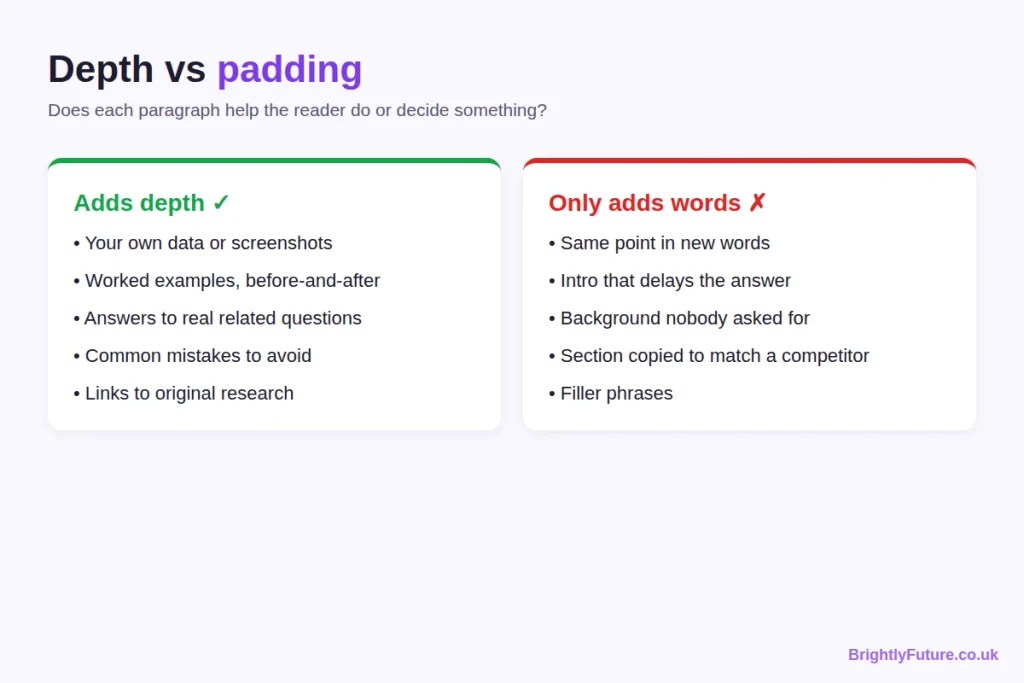
Signs of padding:
- the same point repeated in different words
- an introduction that delays the answer
- background the reader didn’t ask for
- a section added only because a competitor has one
- filler phrases like “it’s important to note” and “in today’s digital world”
What adds real depth:
- your own data, results or screenshots
- a worked example or before-and-after
- answers to related questions searchers actually ask
- common mistakes and how to avoid them
- links to original research instead of vague claims
For editing techniques that cut AI filler and add specifics, see how to humanize AI content. Our free Readability Checker also flags long, hard-to-read sentences, which is where padding often hides.
When should you make an existing post longer?
When Search Console shows it’s being found for questions it doesn’t answer. Open the post in Search Console’s Performance report and look at the queries it gets impressions for. If people are searching for things the post doesn’t cover, add a section that answers them.
That’s expanding for the reader. Adding words to an article that already answers its query doesn’t help, and may make it worse.
Frequently Asked Questions
How long does it take to read a 1,500-word blog post?
About six minutes. A 2019 review of 190 reading studies found that adults read non-fiction silently at about 238 words per minute, so a 1,000-word post takes four minutes and a 2,500-word guide about ten.
Does a longer post earn more from AdSense?
Not by itself. A longer page has room for more ad placements, but earnings depend on traffic and engagement. A padded post that readers abandon early earns less than a shorter one they read to the end and click through from.
Should every post on a blog be the same length?
No. A healthy blog mixes short answer posts, step-by-step guides and longer pillar pages, each as long as its topic needs. The complete guide to AI content writing is an example of a pillar page that covers a broad topic and links out to shorter, focused articles.
How long should a blog introduction be?
Short enough that the answer starts within the first screen on a phone, usually two to four sentences. Say what the reader will get and give the key point straight away; the details can follow.
Write for the question, not the counter
Forget the target number. Work out what the searcher needs, answer it completely, cut what doesn’t help, and let the word count land where it lands. If you want a structured starting draft to shape this way, try the free AI Blog Generator.