

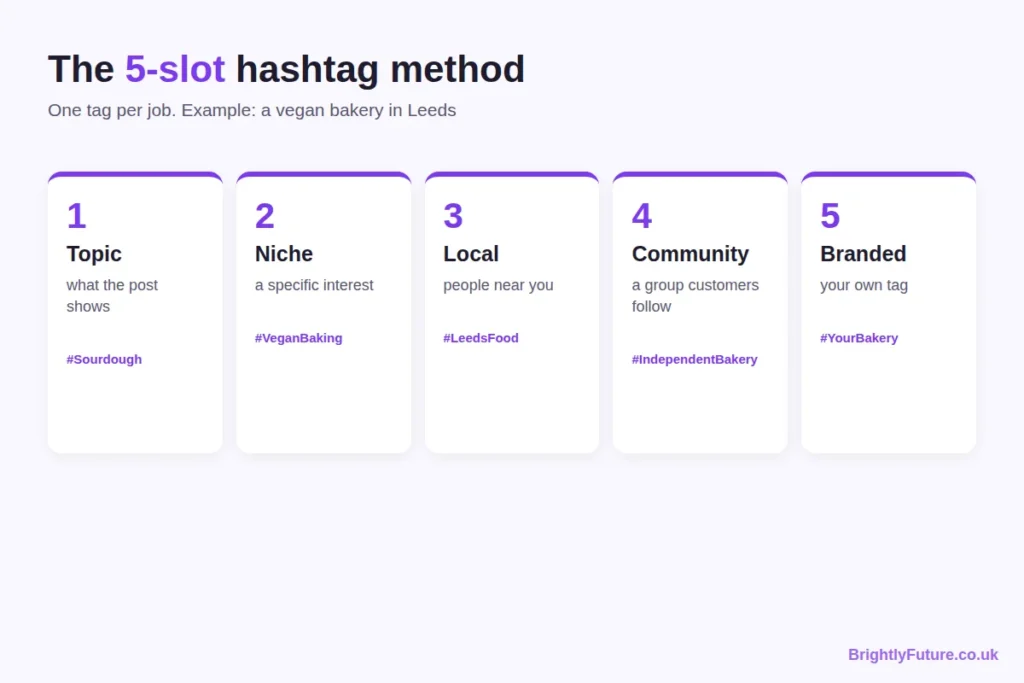
Instagram now allows up to five hashtags per post or Reel, so a business hashtag strategy is about choosing the right five. Use one tag for the topic, one for your niche, one for your location, one for your community or industry, and one branded or campaign tag.
Most hashtag advice online was written for a different Instagram. It tells you to add 20 or 30 tags, or hands you a list of 280 “best hashtags” to copy. Neither works now: Instagram has cut the limit to five, and its own team says hashtags don’t increase reach on their own.
Hashtags still have a job, and with only five slots it’s easier to do well. This guide shows how to choose five that describe your post accurately and reach the people who might actually buy from you, with a ready-made set for six common types of business. It’s part of our social media marketing guide.
Do Instagram hashtags still work for business in 2026?
Yes, as labels. Hashtags tell Instagram what a post is about and help people who search or follow that topic find it. They won’t push an average post to thousands of new people; the post itself does most of that work.
Two changes explain why:
- The five-tag limit. After a year of tests, some of which limited users to three tags, in December 2025 Instagram told users it “will gradually update the number of hashtags that you can include in a caption for a reel or post to five”, replacing the old limit of 30, as Social Media Today reported.
- What Instagram says hashtags do. Instagram chief Adam Mosseri said in February and again in May 2025 that hashtags don’t improve reach, while describing them as a way to say what a post is about (same report).
So a hashtag strategy now has one job: pick the five tags that most accurately describe the post for the people you want to reach.
How many hashtags should a business use on Instagram?
Use up to five on posts and Reels, including carousels; that’s the maximum Instagram allows. Three to five accurate tags is a sensible range. Using fewer is fine when there aren’t five that genuinely fit; a vague tag added to fill a slot only blurs what the post is about.
How do you choose the right 5 hashtags for your business?
Fill five slots, each with a different job: topic, niche, location, community and brand. Then check every tag before you use it. This four-step method works for any type of business.
Step 1: Fill the five slots
| Slot | What it does | Example for a vegan bakery in Leeds |
| 1. Topic | Says what the post shows | #Sourdough |
| 2. Niche | Reaches people with a specific interest | #VeganBaking |
| 3. Local | Reaches people near you | #LeedsFood |
| 4. Community or industry | Joins a group your customers follow | #IndependentBakery |
| 5. Branded or campaign | Collects your posts and customers’ posts in one place | #[YourBakeryName] |
Not every post needs every slot. An online shop that sells across the country may swap the local slot for a second product tag; a seasonal post can use a seasonal or event tag, such as a local food festival, in place of the community slot.
Write hashtags in CamelCase, with a capital letter at the start of each word (#VeganBaking, not #veganbaking). The University of Kentucky’s accessibility guidance recommends it because screen readers can then read the words separately. It’s also easier for everyone to read. Keep each tag to letters and numbers: spaces and symbols such as $ or % break a hashtag.
Step 2: Find hashtags your customers use
Look for tags that buyers search and follow, not tags that other business owners use. #SmallBusinessOwner mostly reaches other business owners; #HandmadeJewellery reaches people looking for handmade jewellery.
Four places to find candidates:
- Instagram search. Type a word related to your post and open the Tags results to see related hashtags.
- Your customers’ posts. Look at what tags your customers use when they post about products or places like yours.
- Similar accounts. Check what successful accounts in your area or niche use, then pick only the tags that describe your post.
- A hashtag tool. Our free Hashtag Generator suggests related tags from a topic.
Step 3: Check every hashtag before you use it
Open each hashtag’s page in Instagram and look at the top posts:
- Are they the kind of content you post? If a tag’s top posts are memes and your post is a product photo, it’s the wrong audience.
- Does the page look normal? If Instagram shows few or no recent posts, or a message that posts are hidden, the tag may be restricted. Don’t use it.
- Is it too broad to mean anything? Tags like #Love or #InstaGood are used for everything, so they don’t tell Instagram what your post is about.
Hashtag sizes change constantly, so check them yourself in the app rather than trusting post counts quoted in old articles.
Step 4: Decide whether you need a branded hashtag
A branded hashtag is unique to your business, such as your name or a campaign phrase. It’s worth having if customers post about you, because it gathers their photos on one page that you and future customers can browse.
Keep it short, easy to spell and clearly yours. Print it on packaging, menus or receipts so customers know it exists. Before you choose one, search it in Instagram to make sure no one else is already using it for something unrelated. If you want to reshare a customer’s photo, ask their permission first and credit them in the caption.
If customers rarely post about you, skip the branded tag on most posts and use that slot for a niche or local tag instead.
What hashtags should your type of business use?
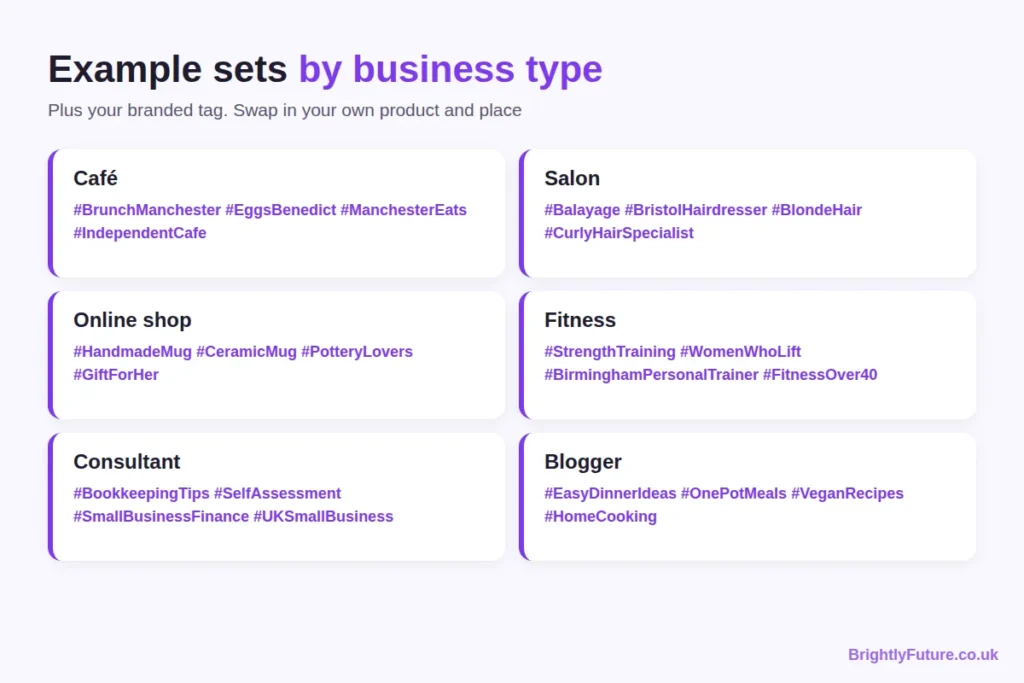
Start from the five slots and adjust them to how your customers search. Each example below shows what to focus on, one sample five-tag set and one mistake to avoid. Swap in your own product, place and business name.
Cafes and restaurants
Focus on location and food type. Most of your customers live or work nearby, so local tags matter more here than for any other business.
Example set (a café in Manchester posting a brunch dish): #BrunchManchester #EggsBenedict #ManchesterEats #IndependentCafe #[YourCafeName]
Mistake to avoid: using only broad tags such as #Foodie and #Yummy. They describe millions of posts and don’t tell anyone where you are.
Salons and beauty businesses
Focus on the service plus the place. People look for a specific result (balayage, gel nails, lash lift) near them, and before-and-after posts suit service tags well.
Example set (a hair salon in Bristol posting a colour result): #Balayage #BristolHairdresser #BlondeHair #CurlyHairSpecialist #[YourSalonName]
Mistake to avoid: tagging services you didn’t show. A post of a haircut tagged #Nails reaches the wrong people.
Online shops
Focus on the product and who buys it, not your location. Your customers search for the thing they want, the style, or the occasion.
Example set (a shop selling handmade ceramic mugs): #HandmadeMug #CeramicMug #PotteryLovers #GiftForHer #[YourShopName]
Mistake to avoid: filling slots with “business owner” tags such as #SmallBusinessOwner or #Entrepreneur. They mostly reach other sellers, not buyers.
Fitness coaches and gyms
Focus on the type of training and the result people want. Add a location tag if you coach in person, or a goal tag if you coach online.
Example set (an in-person personal trainer in Birmingham posting a strength workout): #StrengthTraining #WomenWhoLift #BirminghamPersonalTrainer #FitnessOver40 #[YourName]Fitness
Mistake to avoid: relying on giant motivation tags such as #FitnessMotivation. Some popular fitness tags have also been restricted in the past, so open each one before you use it.
Consultants and B2B services
Focus on the problem you solve and the industry you serve. B2B buyers rarely search Instagram for #Consultant; they search for the topic they need help with.
Example set (a bookkeeper for small businesses posting a tax-deadline tip): #BookkeepingTips #SelfAssessment #SmallBusinessFinance #UKSmallBusiness #[YourBusinessName]
Mistake to avoid: inventing slogan hashtags nobody searches for. A tag that’s unique only because no one uses it gives no one a way to find you. During industry events, use the official event hashtag instead.
Bloggers and creators
Focus on the topic of the post, not the fact that you blog. Readers search for recipes, travel spots or tips, not for #Blogger.
Example set (a food blogger sharing a recipe Reel): #EasyDinnerIdeas #OnePotMeals #VeganRecipes #HomeCooking #[YourBlogName]
Mistake to avoid: using only creator-community tags such as #BloggersOfInstagram. They connect you with other bloggers, which is useful for networking but rarely brings readers. If a post is sponsored or gifted, it must be clearly labelled as an ad. Instagram’s paid partnership label does this without using a hashtag; if you use #Ad instead, it takes one of your five slots.
What hashtag mistakes should businesses avoid?
Most hashtag mistakes come from treating tags as a reach trick instead of a description of the post.
- Copying the same set onto every post. Each post shows something different, so its tags should too. Keep two or three sets for your regular post types and adjust them each time.
- Chasing trending tags that don’t fit. A trending tag on an unrelated post reaches people who scroll straight past.
- Using broad, overused tags. #InstaGood or #PhotoOfTheDay tell Instagram almost nothing.
- Expecting hashtags to work on a private account. Posts from private accounts don’t appear on hashtag pages, so hashtags only help public profiles.
- Expecting hashtags to fix weak posts. The caption and the content still do most of the work. Our guide to writing Instagram captions for business covers that side, including where to place your hashtags.
How do you know if your hashtags are working?
Compare similar posts that use different hashtag sets, over a few weeks, and look at the numbers tied to your goal. A single post tells you little; patterns across several do.
A simple test:
1. Pick two sets for the same type of post, for example one with a city tag and one with a niche-interest tag in that slot.
2. Alternate them for three or four weeks on similar posts.
3. Compare in Instagram Insights: reach from people who don’t follow you, profile visits and follows from each post.
4. Keep the set that wins and test a new change in one slot.
Change one slot at a time. If you swap all five tags at once, you won’t know which change made the difference.
Frequently Asked Questions
Should you use hashtags in Instagram Stories?
You can, but don’t rely on them. Stories don’t appear on hashtag pages the way posts do, as Buffer notes, so a hashtag sticker mostly adds context for people already watching. Put your effort into the five tags on your posts and Reels.
Should you put hashtags in your Instagram bio?
Only your branded hashtag, if you have one. A hashtag in a bio becomes a clickable link to that hashtag’s page, so a generic tag would send visitors away from your profile to other accounts’ posts. Our free Instagram Bio Generator helps you fit the rest of your bio into 150 characters.
Can you use hashtags in other languages?
Yes. Use the language your customers search in. A business serving a local community that speaks another language can use tags in that language; a business selling internationally usually does better with English tags plus one local-language tag where it fits.
Can you change hashtags after you post?
Yes. Edit the caption and change the hashtags like any other text. It’s useful for fixing a typo or a mistaken tag, but test new sets on new posts rather than repeatedly editing old ones, so your results stay comparable.
Should you use the same hashtags on TikTok?
Not automatically. TikTok has its own search, trends and hashtag culture, so a set built for Instagram may not fit. Research TikTok tags separately, starting from the same idea of describing the post accurately for the people you want to reach.
Pick your five for the next post
Before your next post, write down one tag for each slot: topic, niche, location, community and brand. Open each tag’s page to check it fits, post, and note the set you used. After a few weeks of alternating sets, Insights will show you which five bring the right people to your business.