
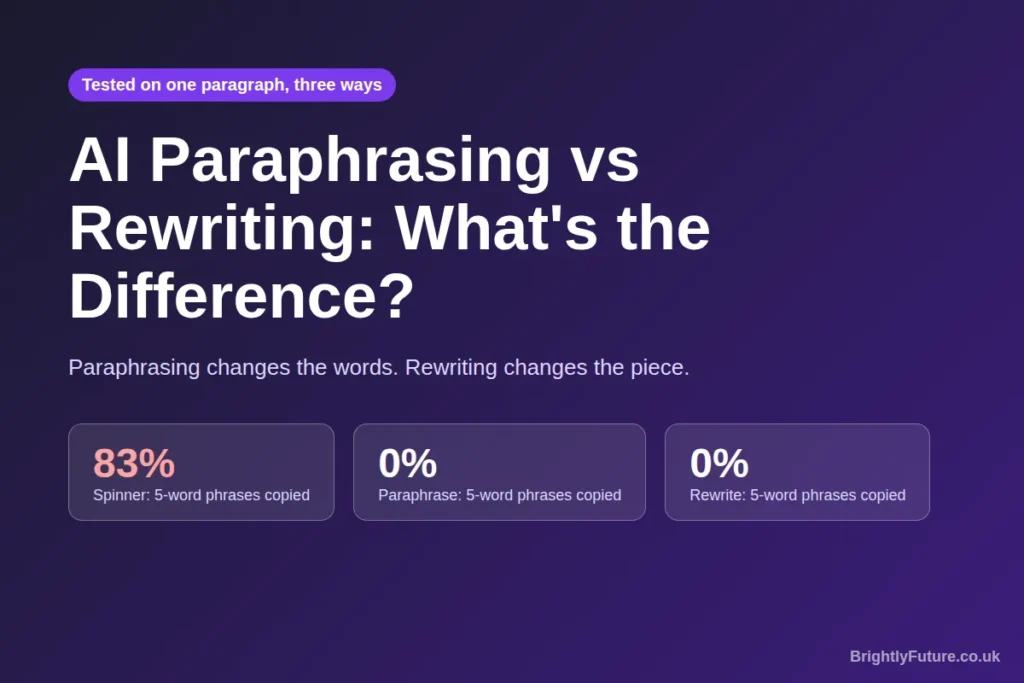
Paraphrasing restates one passage in new words while keeping its meaning, order and length. Rewriting rebuilds the whole piece, often with a new structure, angle or audience. In my test, a synonym spinner kept 83% of the original 5-word phrases; a proper paraphrase and a rewrite kept none.
People use “paraphrase” and “rewrite” as if they mean the same thing. So do most AI tools, which put both labels on the same button. The difference matters, though, because it decides whether your text is original, whether you still need a citation, and whether Google sees your page as new or recycled.
I didn’t want to explain it with definitions alone. So I took one 64-word paragraph and turned it into three versions: a synonym-spinner output, my own paraphrase and my own rewrite. Then I measured how much of the original each one kept.
What is the difference between paraphrasing and rewriting?
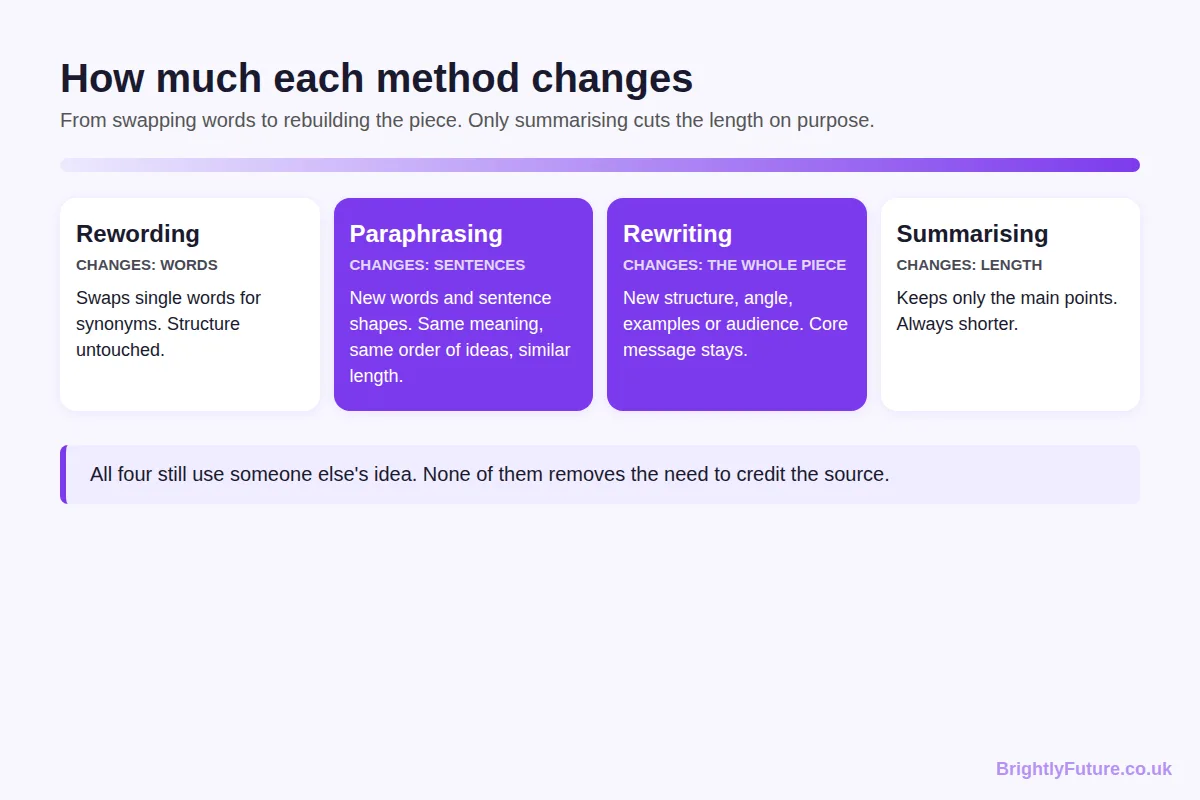
Paraphrasing changes how a passage is worded. Rewriting changes what the piece is built to do. A paraphrase keeps the original ideas in the same order at roughly the same length. A rewrite can reorder, cut, add examples, change the tone or aim at a different reader, as long as the core message survives.
| Paraphrasing | Rewriting | |
| Scope | A sentence or passage | A section or whole article |
| What changes | Words and sentence shape | Structure, angle, tone, examples |
| Order of ideas | Stays the same | Can change completely |
| Length | Close to the original | Anything; often shorter |
| Main use | Citing sources, clarifying a passage | Updating posts, new audiences, fixing weak drafts |
| Citation needed? | Yes, the idea is still the source’s | Yes, if the ideas came from someone else |
Related terms cause the rest of the confusion. Rewording swaps individual words for synonyms and leaves the sentence alone. Summarising keeps only the main points, so it is always shorter than the source. Rephrasing is the loosest of the lot: Scribbr’s guide to paraphrasing, rephrasing and rewording says it can even reorder whole sentences, which overlaps with rewriting. When a tool says “rephrase”, check which one it actually does.
What happened when I paraphrased and rewrote the same paragraph?
The synonym spinner changed 2 of 64 words and kept 83% of the original’s 5-word phrases. My paraphrase kept none of them. My rewrite kept none of them and only 13% of the words in their original order.
Here’s the original paragraph I started with:
“Content marketing works best when every article answers one clear question for one specific reader. Before writing, check what already ranks on Google and note the angle each page takes. Then add something the top results do not have, such as first-hand test data or a free tool. Publishing more posts will not help if each one repeats what readers have already seen.”
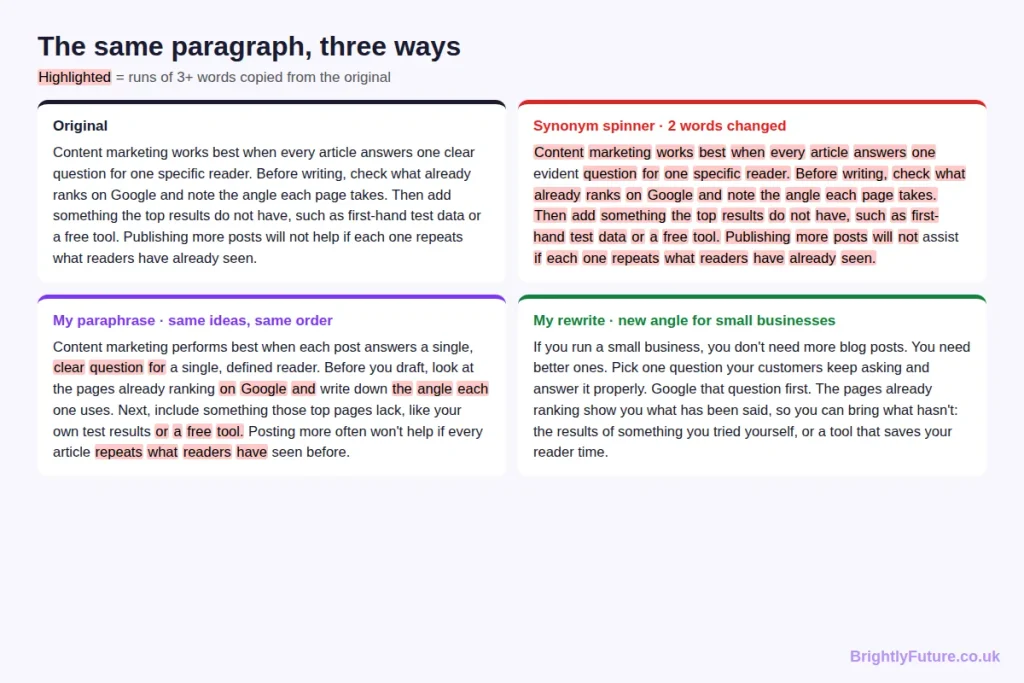
- The spinner swapped “clear” for “evident” and “help” for “assist”. Everything else stayed, word for word.
- My paraphrase kept every idea in the same order: one question per reader, check what ranks, add something new, don’t repeat. I changed the wording and the shape of each sentence.
- My rewrite aimed the same advice at small business owners. It opens with the conclusion (“you don’t need more blog posts, you need better ones”), merges two ideas and drops the word “angle” entirely.
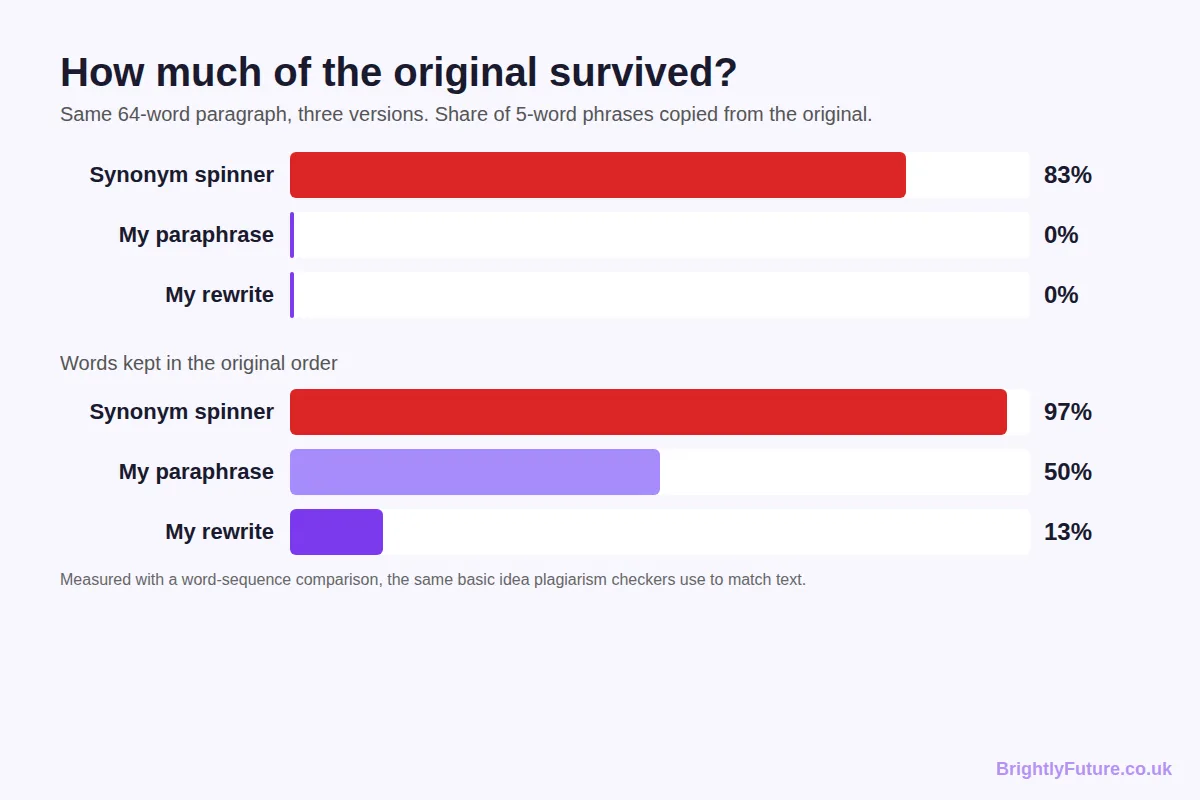
| Version | Words changed | 5-word phrases copied | Words kept in original order |
| Synonym spinner | 2 of 64 | 83% | 97% |
| My paraphrase | Most | 0% | 50% |
| My rewrite | Almost all | 0% | 13% |
I measured overlap by comparing 5-word sequences, a simplified version of how plagiarism checkers match text. The takeaway: a paraphrase can look completely new at the phrase level while still following the source sentence by sentence. That is exactly why it still needs a citation.
When should you paraphrase and when should you rewrite?
Paraphrase when the structure already works and only the wording needs to change. Rewrite when the piece itself needs a new shape, audience or purpose.
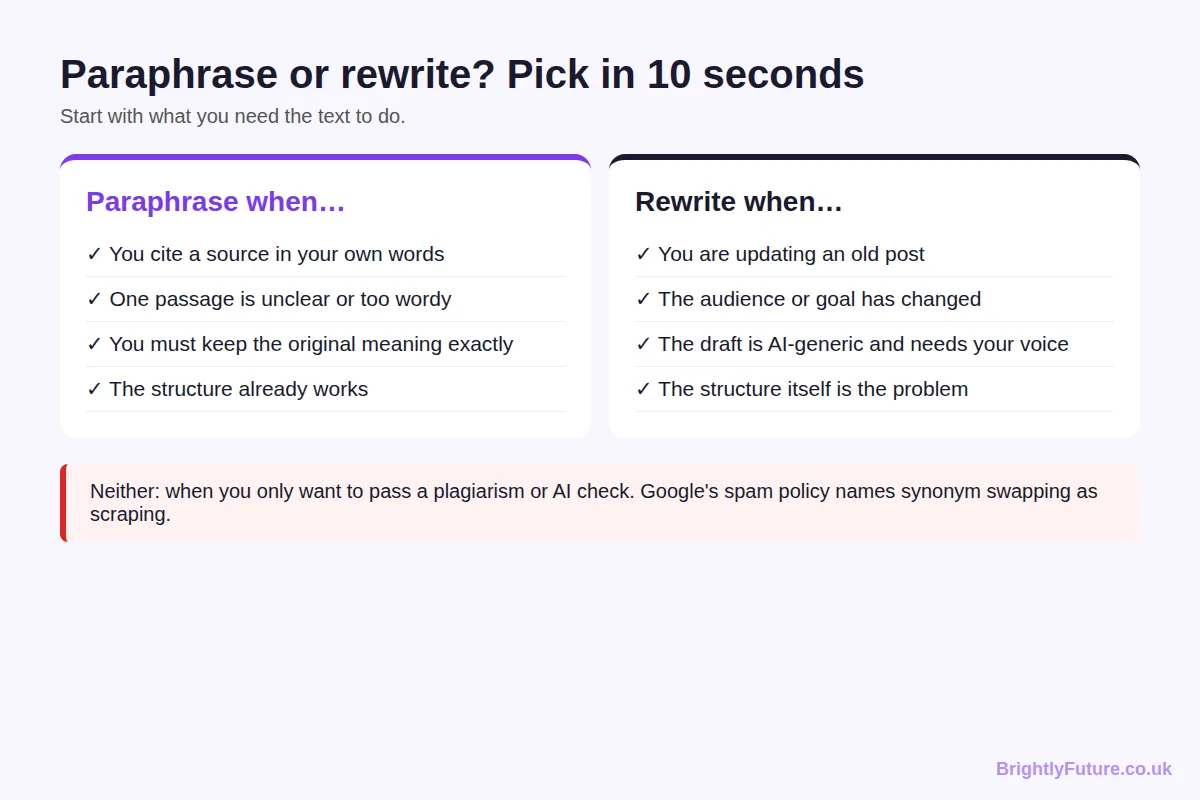
- Paraphrase to bring a source’s idea into your post in your own words, to make one unclear or wordy passage plainer, or when the meaning must stay exactly the same.
- Rewrite to refresh an old post, to adapt a piece for a new audience or channel, or to turn a generic AI draft into something with your voice and examples.
- Do neither when the only goal is to get past a plagiarism or AI checker. That is the use case Google’s spam policy and Turnitin’s detection now target.
A good paraphrase takes four moves: read the passage until you can explain it without looking, write your version from memory, compare it with the original, then change any phrase that still matches and add the citation.
Is paraphrasing considered plagiarism?
Paraphrasing is not plagiarism when you credit the source and genuinely restate the idea in your own words. It becomes plagiarism when you skip the credit, or when you only swap a few words and keep the author’s sentence structure.
Scribbr’s guidance on whether paraphrasing is plagiarism makes the same point: if your text stays too close to the original, deleting a few words or swapping in synonyms still counts as plagiarism, even with a citation. My spinner result shows why. With 83% of its 5-word phrases unchanged, a plagiarism checker would flag it as a near-copy.
Rewriting follows the same rule. If the ideas, research or structure came from someone else, credit them. Changing every word doesn’t make an idea yours.
Can AI paraphrase without plagiarism?
Yes, if the AI changes sentence structure as well as words, you check the output, and you still cite the source of the idea. The risk comes from tools that only swap synonyms, and from people using any tool to hide where a text came from.
Two changes since 2025 matter here:
- Turnitin now looks for disguised AI text. On 27 August 2025, Turnitin launched AI bypasser detection, trained on the patterns that leading humanizer tools leave behind. Running AI text through a humanizer is no longer a reliable way to hide it.
- Google names synonym swapping as spam. Google’s spam policies, updated in August 2026, list copying content and modifying it “only slightly (for example, by substituting synonyms or using automated techniques)” as scraping.
The safe way to use AI for either job:
1. Feed it your own draft or notes, not someone else’s article.
2. Tell it which one you want. “Paraphrase this paragraph, same meaning and length” and “Rewrite this section for beginners, new structure, keep these facts” produce very different results.
3. Read the output against the original. Put back any fact it dropped or changed.
4. Cite every source whose idea you used.
My guide on how to humanize AI content covers step 3 in detail.
Does Google penalise paraphrased content?
Not for being paraphrased. Google’s Search Quality Rater Guidelines (current version dated 11 September 2025) give the Lowest rating when almost all of a page is “copied, paraphrased, embedded, auto or AI generated, or reposted from other sources with little to no effort, little to no originality, and little to no added value for visitors”. The problem is the missing value, not the method.
So the question isn’t “paraphrase or rewrite?” It’s “what did I add?” For a blog, that usually means a rewrite plus something the source didn’t have: your test, your data, your example. For how Google treats AI-assisted writing more broadly, see can Google detect AI content?
Which AI tool is best for paraphrasing vs rewriting?
The best tool depends on the job. Sentence-level paraphrasers suit short passages. Chat-based AI suits full rewrites because you can tell it the audience, structure and facts to keep.
- QuillBot – the best-known paraphraser. The free plan limits how many words you can paraphrase at once and which modes you can use; the paid plan removes those limits.
- Spinbot and other synonym spinners – swap words at speed. Fine for brainstorming alternative phrasings, risky for anything you publish, for the reasons my test showed.
- WordAI – an article rewriter built for longer content rather than single sentences.
- Grammarly – offers rewrite suggestions for clarity and tone inside your existing draft.
- Jasper and Copy.ai – marketing writing platforms that include rewriting tools for ad and web copy.
- Claude and ChatGPT – the most flexible for true rewriting, because you can give them a brief. I compared them in best AI blog writing tools.
After my test, I rebuilt our own free paraphraser so it does more than swap words. It sends your text to a free AI model to rewrite the sentences, and falls back to a built-in rule engine if the AI service is busy. Your text isn’t saved by BrightlyFuture, but it does leave your browser, so don’t paste anything confidential. The tool also shows a “Phrases kept” score: the share of 5-word phrases still matching your original, the same measure I used above. Use it to spot sentences that are still too close to the source.
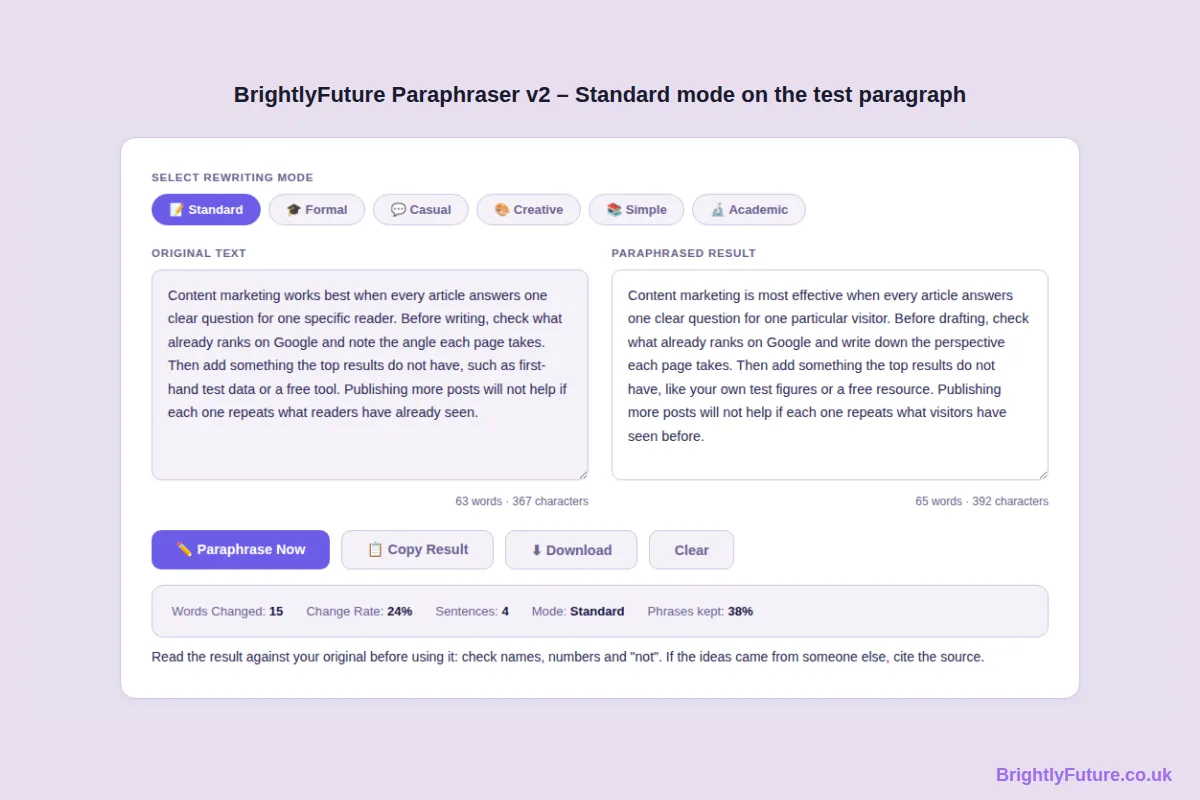
Whatever you use, run the result through the readability checker afterwards. Many paraphrasers swap short words for longer ones and make text harder to read.
Frequently Asked Questions
Should I paraphrase or quote a source?
Quote when the exact wording matters: a definition, a striking line or a claim you want to show precisely. Paraphrase when only the idea matters and you can say it more simply for your readers. Most blog posts need far more paraphrasing than quoting.
How do I cite a paraphrase in a blog post?
Name the source in the sentence and link to the original page, for example “Scribbr explains that…” with a link on the source name. Academic styles such as APA also need the author and year in brackets plus a reference list entry.
Can I paraphrase my own old blog post and publish it again?
You can, but you rarely should. Two near-identical posts on the same site compete for the same searches. Update the original URL instead, or if you do publish a new version, 301-redirect the old one to it.
Is it cheating to use a paraphrasing tool at university?
It depends on your institution’s policy. Many universities allow tools for language support but treat undisclosed AI rewriting of submitted work as misconduct. Check your course rules and declare the tool if they ask.
Credit and added value matter more than the words
Paraphrase when you need someone else’s idea in your words. Rewrite when your own piece needs a new shape. Either way, the words are the easy part; credit and added value are what keep your content honest and worth ranking.
For the full process from draft to publish, see the step-by-step guide to writing a blog post with AI.
For the bigger picture on tools, SEO and Google’s rules, start with our complete guide to AI content writing.