
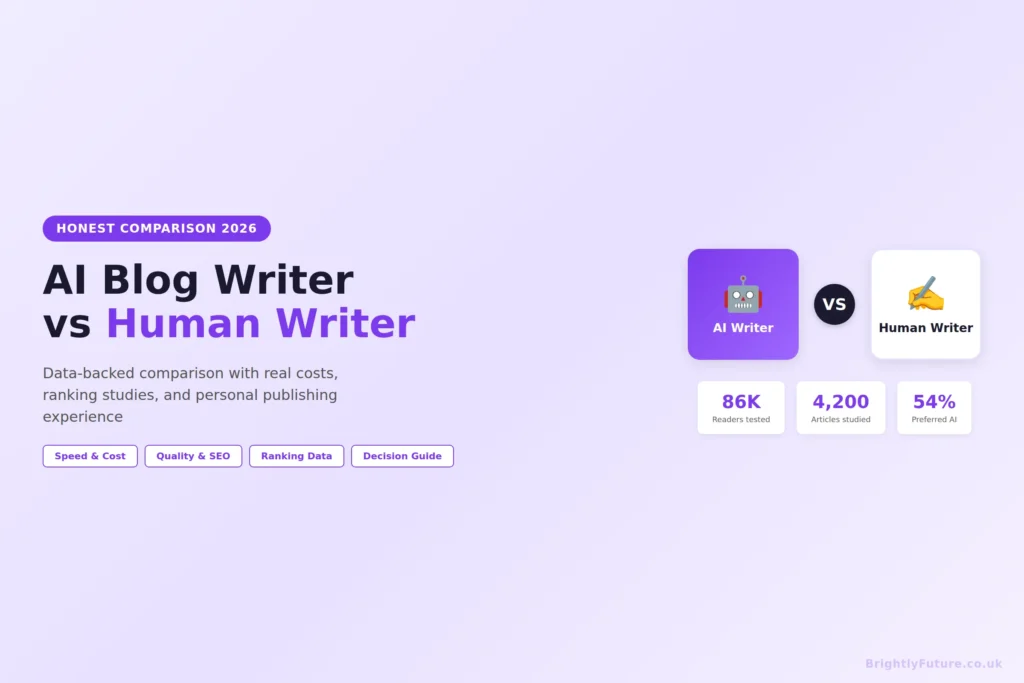
Neither wins on its own; effort does. In Digital Applied’s 16-month study of 4,200 articles, pure AI content ranked 23% lower than human writing, while AI drafts with heavy editing and original data came within 4%. Research and editing matter more than who typed the draft.
Most comparisons of AI and human writers pick a side. I think they ask the wrong question. Content that wasn’t researched, doesn’t answer the searcher’s question and adds nothing new is useless, whether a person wrote it or an AI tool did.
I’ve seen both sides. Most of the “original” articles I’ve bought from freelancers were reworded competitor posts. And the articles I’ve drafted with Claude rank and keep climbing on two of my sites, because of the research and editing I put into each one.
This comparison sets out what each approach delivers, what the ranking data says, what each costs in 2026 and when to use which. It’s part of our complete guide to AI content writing.
Does Google rank human content higher than AI content?
At the very top of the results, yes, but the gap mostly disappears once AI drafts are properly edited. What Google penalises is low-value content, not the tool behind it. Whether Google can spot AI text at all is a separate question, covered in can Google detect AI content.
Four studies show the pattern:
- Position 1 favours human-led content. Semrush analysed 42,000 blog posts ranking for 20,000 keywords and found content classified as human-written in the number one spot 80% of the time, against 9% for content classified as purely AI. The gap narrowed from position 5 down.
- Edited AI nearly matches human writing. Digital Applied tracked 4,200 articles across 140 domains for 16 months. Pure AI content ranked 23% lower than human writing and was deindexed 3.2 times as often after spam updates. AI drafts with substantial editing, original data and expert attribution came within 4%.
- Unedited AI fades over time. In a 6-month study of 200 paired articles, AI articles were indexed faster and ranked higher at first. By month six, the human articles held a 5-position median lead and had earned four times as many editorial backlinks (a median of 8 against 2).
- AI is already everywhere. Ahrefs checked 900,000 new web pages in April 2025 and found AI-generated text in 74.2% of them. Most pages that rank today were written with some AI help.
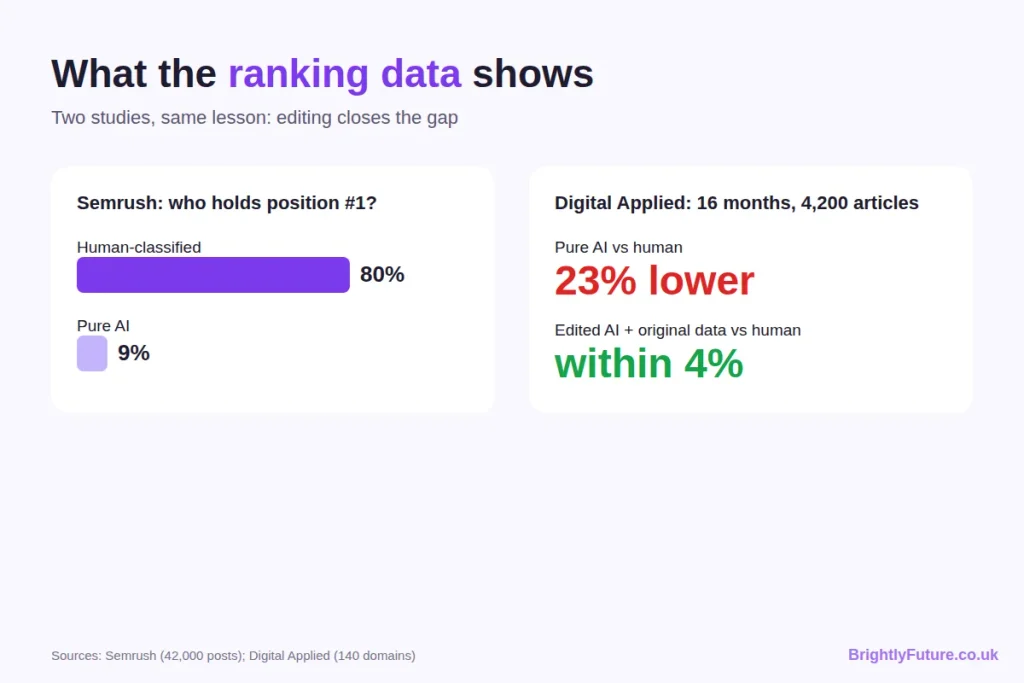
One detail most write-ups skip: Semrush sorted pages into “human” and “AI” with an AI detector (GPTZero). A well-edited AI draft often reads as human to a detector, so the “human” group almost certainly includes AI-assisted pages that were edited properly. That supports the same conclusion: editing is what moves a page up.
Can AI write like a human, and can readers tell?
Often they can’t, and in one large test they preferred the AI. In March 2026 The New York Times ran a blind quiz in which 86,000 readers compared five pairs of passages, and 54% preferred the AI versions overall.
The test had a catch. The human passages came from famous authors such as Carl Sagan and Ursula K. Le Guin, and the AI (Claude Opus 4.5) was asked to write its own version of each. It measured which prose people liked, not whether a blog post was accurate, useful or based on experience. A reader can enjoy a paragraph and still be misled by it.
For a blog, sounding good is the easy part. Readers come back, and Google keeps you ranked, when the advice is correct and specific.
Is AI writing better than human writing? Pros and cons
AI wins on speed, cost and volume. A skilled human writer wins on experience, original ideas and judgement. Neither wins on accuracy by default: AI invents facts confidently, and rushed writers copy errors from the pages they reword.
| Factor | AI writer | Human writer |
| Speed | A full draft in minutes | Hours to days, including research |
| Cost | $0–79 a month for tools | $150–1,500 per article |
| Accuracy | Invents facts and sources; every claim needs checking | Depends on the writer’s research habits |
| Original ideas | Recombines what already exists | Can bring new angles, tests and opinions |
| First-hand experience | None of its own | The writer’s, if they have it |
| Volume | Limited only by your editing time | Limited by the writer’s hours |
| Brand voice | Follows a written style guide well | Learns it over a few pieces |
The table hides the point that matters most: both columns describe a draft, not a finished article. What turns either into something worth publishing is research before writing and editing after it.
Why does a lot of “human-written” content fail?
Because much of what’s sold as human-written is competitor content in new words. From my experience hiring and reviewing writers, roughly 80% of the “original” articles I received were some form of spun content.
The pattern is easy to spot once you know it. The writer takes the top three or four ranking articles, merges their structure, rewrites the sentences enough to pass Copyscape, and delivers it as new work. The text is technically unique, but it contains no new information, test or opinion.
Google’s guide to creating helpful content asks directly whether a page provides “original information, reporting, research, or analysis”. Spun content fails that question whoever wrote it. Rewording and genuine rewriting are different jobs; AI paraphrasing vs rewriting explains where the line sits.
Good human writers still exist. Specialists who interview sources and write from real knowledge produce work AI can’t match, but they charge accordingly: senior and specialist writers typically quote $600–1,500 per article. So when someone says human content is better, ask which human: a $50 rewriter or a specialist?
Why does raw AI content fail?
Because most people use AI like a vending machine: type a topic, get an article. Ask any AI tool for “a 1,500-word blog post about X” and you’ll get a clean, well-structured article that says nothing the top ten results don’t already say.
AI content ranks when the research behind it is real. My process for every article:
1. Keyword research in Semrush and Ahrefs to find the main and supporting queries.
2. Competitor analysis of the 10–12 pages that rank, noting what each misses.
3. A structure built on user intent, with each heading answering a question searchers actually ask.
4. A detailed brief for Claude with the competitor gaps, structure, sources and my own notes, drafted section by section.
5. A three-round audit: first with the AI that wrote it, then a cross-check with a different AI, then my own line-by-line review and fact-check.
That takes four to five hours per article. It’s slower than AI marketing promises, but it’s what makes the content rank.
The results. These two sites were written this way, drafted with Claude and researched and edited by me:

Health and fitness site: Search Console performance, 6 month Health and fitness site, 29 March to 28 September 2026: 5,690 clicks, 1.14 million impressions, average position 7.7, with daily traffic still rising.
Second site: Search Console performance
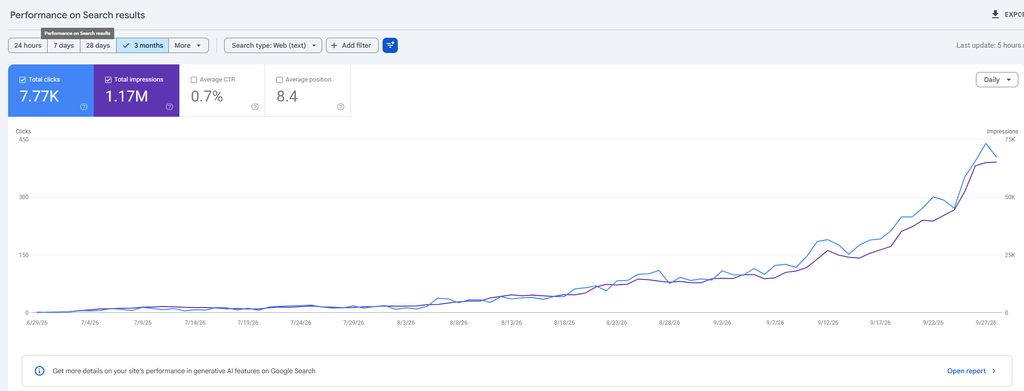
Fashion and Lifestyle: Search Console performance, 5 month, 7770, 1.17M impressions and average position from the screenshot.
The articles work because of the research and the editing, not because AI wrote the words. The full step-by-step method is in how to write a blog post using AI.
How much does each approach cost?
AI tools cost far less per article, but only the hybrid approach gives you low cost and quality together, because you pay with your own time instead.
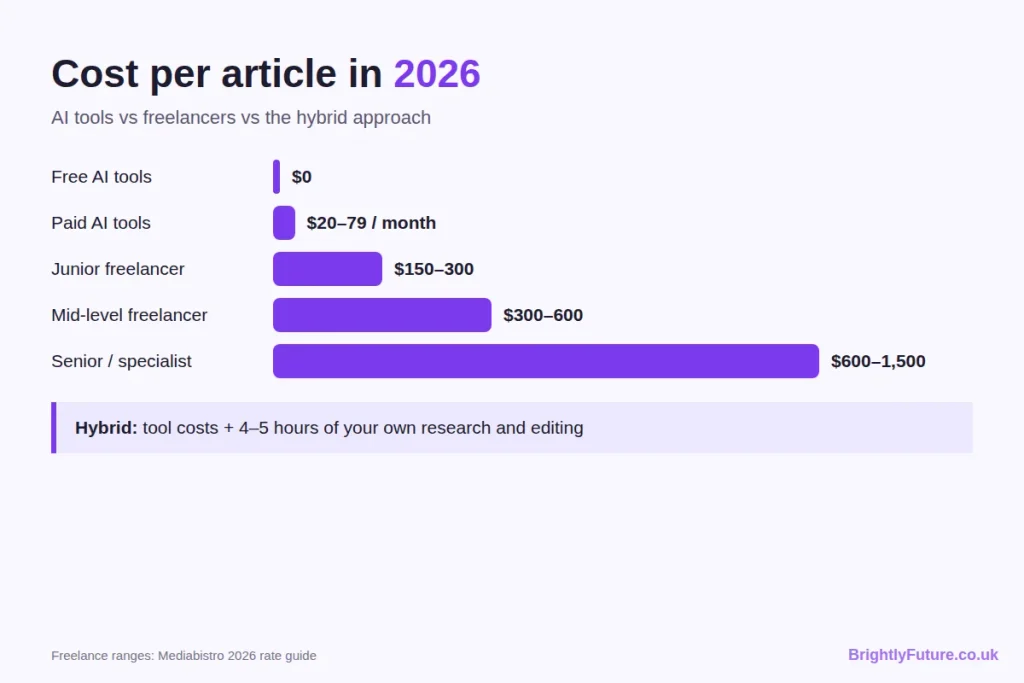
| Approach | Typical cost per article | What you get |
| Free AI tools (Claude, ChatGPT, Gemini) | $0 | A raw draft that needs research and heavy editing |
| Paid AI and SEO tools | About $20–79 a month in total | A better-structured draft, still needing editing |
| Junior freelancer (0–2 years) | $150–300 | Variable quality; high risk of spun content |
| Mid-level freelancer (3–5 years) | $300–600 | Decent quality; research depth varies |
| Senior or specialist writer | $600–1,500 | Expert work, limited availability |
| Hybrid: AI draft + your research and editing | Tool costs + 4–5 hours of your time | Researched, in your voice, best value |
*Freelance ranges: Mediabistro’s 2026 rate guide for 800–1,500-word blog posts. Specialist niches such as finance or health typically cost 20–40% more.*
The hidden cost is revisions. A cheap draft that needs rewriting costs you the same hours as editing an AI draft, plus the fee. With AI you control the inputs from the start: the research, the brief and the structure. The editing steps are in how to humanize AI content, and our free AI Paraphraser helps with stiff sentences, though not with missing ideas.
Should you use AI or hire a writer?
Match the approach to the content, not to a general preference.
Use AI, with your own research and editing, when:
- you’re writing informational posts, how-to guides or comparisons
- you know the subject but have little time to write
- you need to publish more without hiring
Hire a human writer or copywriter when:
- the article needs interviews, quotes or original research
- it’s a health, finance or legal topic where the author’s credentials must be real
- it’s a thought-leadership piece that has to sound like a specific person
Use both when:
- you’re building a topic cluster with a pillar page and supporting articles
- you want a writer to edit and add expertise to AI drafts instead of starting from zero
For tools to start with, see the best AI blog writing tools, compared by budget.
Will AI replace human content writers?
It’s replacing parts of the work, not the writers who adapt. Most content teams already use AI for research, outlines and first drafts, and still pay people for the parts that need judgement.
The tasks that are disappearing were always the low-value ones: compiling research, rough first drafts, formatting and meta descriptions. What AI can’t do is interview a customer, test a product, spot an industry change before the keyword tools do, or know which paragraph will lose a reader’s trust. Writers who combine those skills with AI produce more and better work than writers who refuse to use it.
Frequently Asked Questions
How do you keep one brand voice across AI drafts and human writers?
Write the voice down once and give the same document to both. A one-page style guide (words you use and avoid, sentence length, spelling, how you address the reader, two sample paragraphs) works for freelancers and AI alike. I keep mine inside Claude as project instructions plus a writing skill, so every draft starts with the same rules.
How do you test a freelance writer before hiring them?
Pay for one short trial piece on a real topic from your list, with the same brief you’d give an AI. Ask for their sources and outline first. Then compare the draft with the current top results: a good writer adds at least one point, example or source you haven’t seen there. Their questions about the brief tell you as much as the draft.
Can an AI detector tell you if a freelancer used AI?
Not reliably. Detectors guess from writing patterns, flag some human writing, and miss AI text that’s been edited. Use one as a prompt for a conversation, not as proof. A better check is to ask for the writer’s sources and notes. Our free AI Content Detector shows why each sentence was flagged.
Is AI content good enough for health, finance or legal topics?
Not without expert review. Google holds these “Your Money or Your Life” topics to a higher standard because wrong advice can cause real harm, and AI regularly gets dosages, legal details and financial rules wrong. AI can help structure and draft, but a qualified professional should verify every claim, and the byline should belong to someone with real credentials.
The honest answer: effort beats the tool
AI writers and human writers aren’t really competing. Lazy processes are competing with careful ones, and the careful process wins whatever produced the first draft.
The worst AI content is an unedited chatbot draft. The worst human content is a competitor article in new words. Both fail for the same reason: nobody did the research, and nobody checked whether the reader’s question was answered.
See what a structured first draft looks like with our free AI Blog Generator, then follow the step-by-step guide to turn it into an article that deserves to rank.