

To write blog headlines that get clicks, study the top 10 Google results first, match their format, then add one angle they lack. Keep titles to 40–60 characters, put the keyword early, and skip square brackets, which Google rewrote in 77.6% of titles in Zyppy’s study.
Before I write a single headline, I read the top 10 Google results for the keyword. Not the articles. The titles. They show me what Google already believes the searcher wants, and what nobody has offered yet.
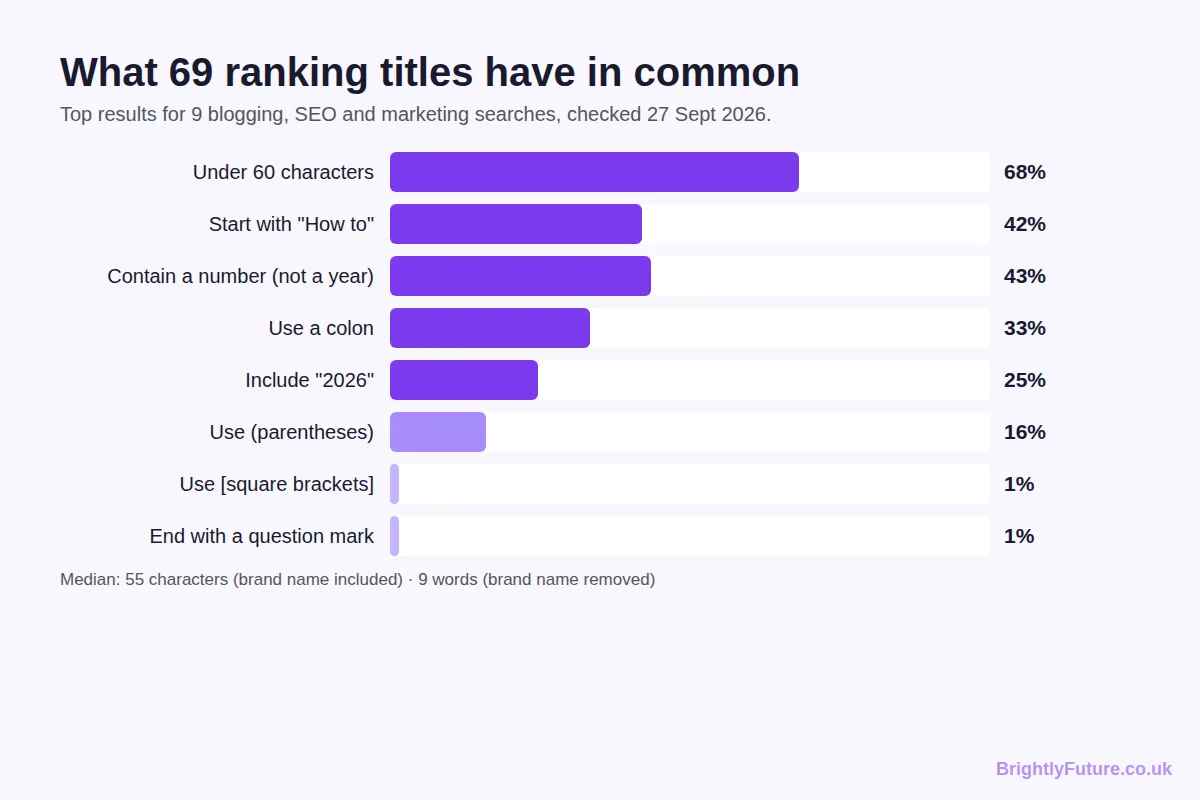
For this guide, I turned that habit into data. I collected 69 ranking titles across 9 blogging, SEO and marketing searches and counted what they share. Below you’ll find those patterns, what SEO studies say about length, numbers and title rewrites, and a free headline analyzer to check your own.
What makes a good blog headline?
A good blog headline matches what the searcher wants, contains the keyword they typed, makes a specific promise, and describes an article that keeps that promise. It does all of that in about 60 characters. Miss any one and the click either never happens or turns into a quick exit.
- Intent match. Someone searching “best AI writing tools” wants a list, not a tutorial. The wrong format loses before wording even matters.
- Keyword early. Searchers scan for the words they typed. Front-loading them also protects the keyword if Google cuts the end.
- A specific promise. “12 tips”, “tested”, “with templates”, “in 10 minutes”. Vague headlines like “Tips for Better Headlines” give no reason to pick you over nine others.
- Honesty. Google’s own title link guidelines ask for descriptive, concise titles and warn against keyword stuffing and boilerplate. A headline that overpromises may earn the click, but the reader leaves fast.
How do you find the right headline format for a keyword?
Search the keyword, then read the titles of the top 10 results before you write anything. The pattern they share is the format Google currently rewards for that search. Your headline should follow that format and then stand out through its angle.
Ahrefs calls this the 3 Cs of search intent: content type, content format and content angle. Their guide, written by Mateusz Makosiewicz, puts it plainly: when creating content for search intent, “it makes the most sense to follow the crowd.”
That matches my own experience. When I checked the searches below, the format was obvious within seconds:

- “how to start a blog” – all 7 results started with “How to”. A list title would look out of place.
- “best AI writing tools” – zero “How to” titles. Four were numbered lists and three used the word “tested”.
- “SEO tips for beginners” – zero “How to” titles. Six of eight called themselves a guide.
One correction to the common version of this advice: follow the format, never the wording. If your title reads like the other nine, the searcher has no reason to choose it. For “best AI writing tools”, every result says “best” and most have a number, so the angle that stands out is proof: how many tools you tested, how you tested them, or a result nobody else shows.
Which headline formulas work for blog posts?
The best headline formula is the one that matches the format already ranking for your keyword. These five cover almost every blog search. Fill the brackets with your own keyword, number and benefit:
| Search intent | Formula | Example |
| Learn a process | How to [outcome] (without [pain]) | How to Start a Blog Without Paying for Hosting |
| Compare options | [N] Best [keyword] for [audience] ([proof]) | 12 Best AI Writing Tools for Bloggers (Tested) |
| Choose between two | [X] vs [Y]: Which Is Better for [goal]? | Claude vs ChatGPT: Which Is Better for Blog Posts? |
| Understand a concept | What Is [keyword]? [benefit] Explained | What Is Search Intent? The 3 Cs Explained |
| Get ideas or examples | [N] [keyword] Examples That [result] | 25 Blog Title Examples That Earned Page-One Clicks |
Only one line in that table ends in a question mark, and it’s the one where the searcher is asking a question. That fits Backlinko’s CTR data (covered in the wording section below): questions don’t lift CTR by themselves, so use them when the query itself is a question.
Keep a swipe file, a habit Copyblogger recommends in its headline guide: every time a title makes you click, save it in a note with the search you typed. After a month you’ll have your own formula list built from your niche, not a generic one.
The line to hold is click-worthy, not clickbait. Every word in the formula must be true of the article. “Tested” means you tested. “Complete” means nothing important is missing.
How many words should a blog headline be?
Aim for 6–12 words and 40–60 characters for a blog title that shows in Google. Longer titles usually get cut off or rewritten, and very short ones don’t carry enough detail to win the click.
Three datasets point to the same range:
- Backlinko’s CTR study of about 4 million Google results found that title tags between 40 and 60 characters have the highest organic click-through rate.
- Zyppy’s study of 80,959 titles across 2,370 sites found that titles of 51–60 characters were rewritten least often, 39–42% of the time. Titles over 70 characters were rewritten 99.9% of the time.
- My sample of 69 ranking titles had a median length of 55 characters including any brand name, and 9 words without it. 68% were 60 characters or fewer.
Social media is different. BuzzSumo’s analysis of 100 million articles published in 2019–2020 found that headlines of around 11 words and 65 characters earned the most engagement. If a post matters more on LinkedIn or Facebook than in Google, set a separate social title with Yoast or Rank Math, and keep the SEO title under 60.
Do numbers in headlines increase clicks?
Numbers help when the searcher expects a list, and they add little when the searcher wants a single process. “27 Best AI Writing Tools” fits a comparison search. “7 Ways to Start a Blog” would look odd when every top result for that search is a step-by-step how-to.
In my sample, 43% of ranking titles contained a number other than a year. But the spread depended on the search: none of the “how to start a blog” titles led with a number, while four of the seven AI tool titles did.
When you do use a number, a few things hold up:
- Use digits, not words. “7” is faster to scan than “seven”.
- Pick a number your content actually earns. BuzzSumo found 10 was the best-performing number in social headlines, followed by 3–9. A “101 tips” list that repeats itself loses readers halfway.
- Numbers as proof. “I tested 25+ tools” or “69 titles analysed” works harder than a list count, because it signals effort no one else put in.
Years work the same way. A quarter of my sample included “2026”, mostly on searches where freshness matters, like tools and guides. If you add a year, update the post every year or the title starts working against you.
Which headline words make people click?
Specific benefit words and proof words earn clicks. Hype and fake suspense lose them. The strongest words tell the reader what they get: “free”, “tested”, “examples”, “templates”, “step-by-step”, “checklist”.
What the data says about wording:
- Positive beats negative, slightly. Backlinko found titles with a positive sentiment had about a 4% higher CTR than negative ones.
- Questions don’t add clicks in Google. The same study found question and non-question titles had similar CTRs. Only 1 of my 69 ranking titles ended with a question mark.
- Clickbait phrases faded. BuzzSumo saw emotional hooks like “will make you cry” dominate social headlines in 2017 and nearly disappear by 2020, replaced by practical, expert-led phrasing.
The Emotional Marketing Value (EMV) score, one of the older headline tools, measures how many emotional words a headline contains. That can help for social posts. For search, a clear promise usually beats an emotional one, because the searcher already has a problem and wants it solved.
Why does Google rewrite blog titles, and how do you stop it?
Google rewrites a title when the title tag doesn’t describe the page well. Its title link documentation, last updated in December 2025, names the usual causes: half-empty titles, outdated ones (such as an old year), inaccurate ones, repeated boilerplate across pages, and pages with no clear main heading. The replacement can come from your H1, other headings, `og:title` or the anchor text of links pointing to the page.
It happens a lot. Zyppy found Google rewrote 61.6% of the title tags it studied. The triggers they identified are easy to avoid:
| Title habit | What Zyppy found | What to do | |
| Over 60 characters | Over 76% chance of a rewrite (99.9% past 70) | Keep to 51–60 characters | |
| 20 characters or fewer | Over 50% chance of a rewrite | Add the benefit or detail | |
| [Square brackets] | Rewritten 77.6%; bracket text removed 32.9% | Use (parentheses) instead | |
| (Parentheses) | Rewritten 61.9%; text removed 19.7% | Safe to use sparingly | |
| Pipe separator \ | Removed or replaced 41.0% of the time | Use a dash – instead | |
| Dash separator – | Removed 19.7% of the time | Preferred separator |
That table settles a debate I see in many headline guides. HubSpot cites research on 3.3 million paid headlines where bracketed clarifiers performed 38% better, with “[Template]” earning the most views. That was paid link placements, not organic search. In Google, brackets are the fastest way to get your title rewritten. It’s why my own titles use “(With Analyzer)” rather than “[With Analyzer]”, and why only 1 of 69 ranking titles in my sample used square brackets.
A newer factor: in March 2026, Google confirmed it is testing AI-generated headline rewrites in regular search results. Google called the test “small and narrow”, but it used similar language before AI headlines became a regular feature in Google Discover. The best protection is the same as before: a title that already describes the page so well there’s nothing to improve.
What is the best process for writing blog headlines?
Read the top 10, find the gap, write ten versions, check them, then measure. This is the routine I follow for every BrightlyFuture post, and each step takes minutes.
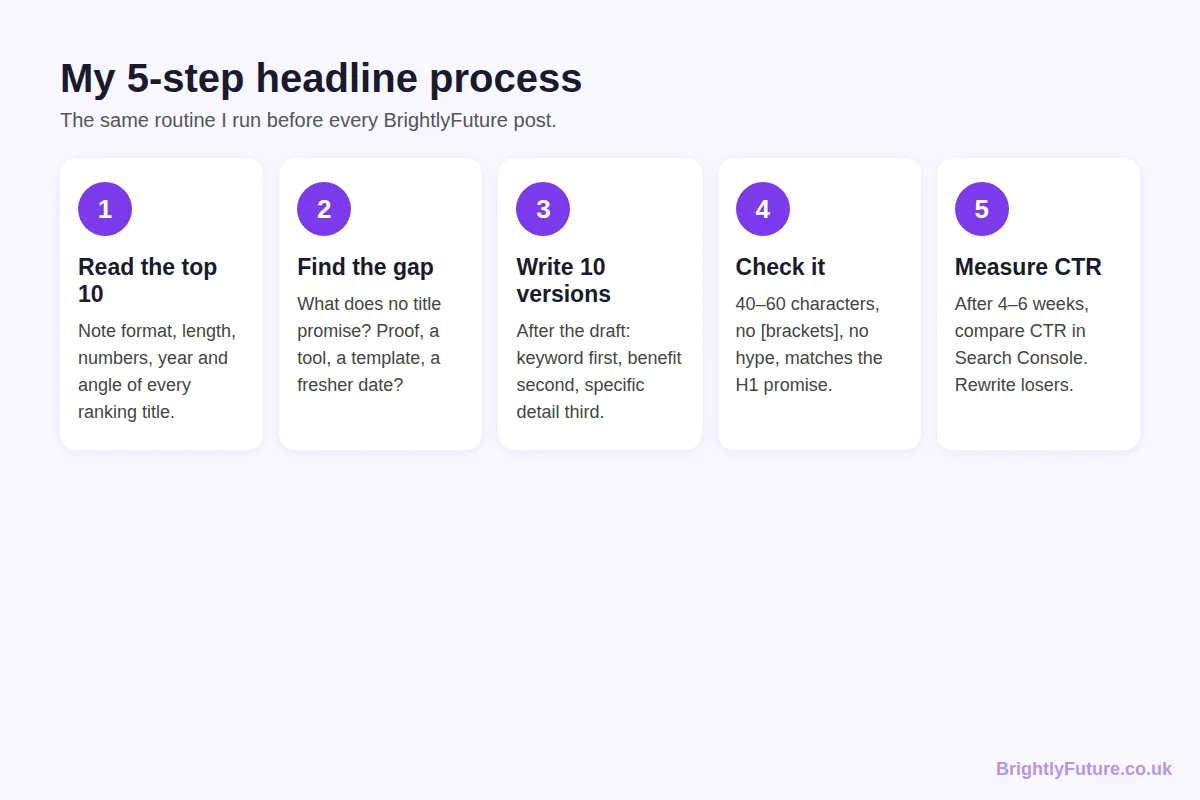
1. Read the top 10 titles. Note the format, length, whether they use numbers or a year, and the angle each one takes.
2. Find the gap. Look for what no title promises: first-hand testing, a free tool, templates, newer data, or a narrower audience.
3. Write ten versions after the draft. Start with a working title, then write the final headline once the article exists, because the content often ends up promising something sharper than you planned. Begin each version with the keyword, add the benefit, then the specific detail. The first few will be obvious. The good one usually shows up around version six or seven.
4. Check the shortlist. 40–60 characters, no square brackets, no hype words, and a promise the article keeps.
5. Measure CTR after four to six weeks. In Google Search Console, open Performance, filter by the page and compare CTR with pages at a similar average position. If it trails, rewrite the title and check again a month later.
AI can speed up step 3. Ask Claude or ChatGPT for ten headlines that include your keyword, stay under 60 characters and promise a specific outcome, then edit the best two by hand. Our AI Blog Generator can draft headline options alongside the outline.
What is a headline score, and should you trust it?
A headline score is a 0–100 rating from a headline analyzer, based on rules like word count, character count, word balance and sentiment. It’s useful for catching obvious problems. It is not a reliable predictor of which headline gets more clicks.
The most popular tools score different things:
- CoSchedule Headline Analyzer checks word balance (common, uncommon, emotional and power words), length, headline type, reading level and sentiment.
- Sharethrough was built for native ad headlines. It blends an engagement score and an impression score into one quality score.
- EMV analyzers count emotional words only.
Benjamin Houy tested this directly. He compared the scores of these three tools with the real winners of 23 A/B headline tests on his blog. CoSchedule picked the winner 16 times. EMV managed 9 and Sharethrough 8, which is worse than flipping a coin.

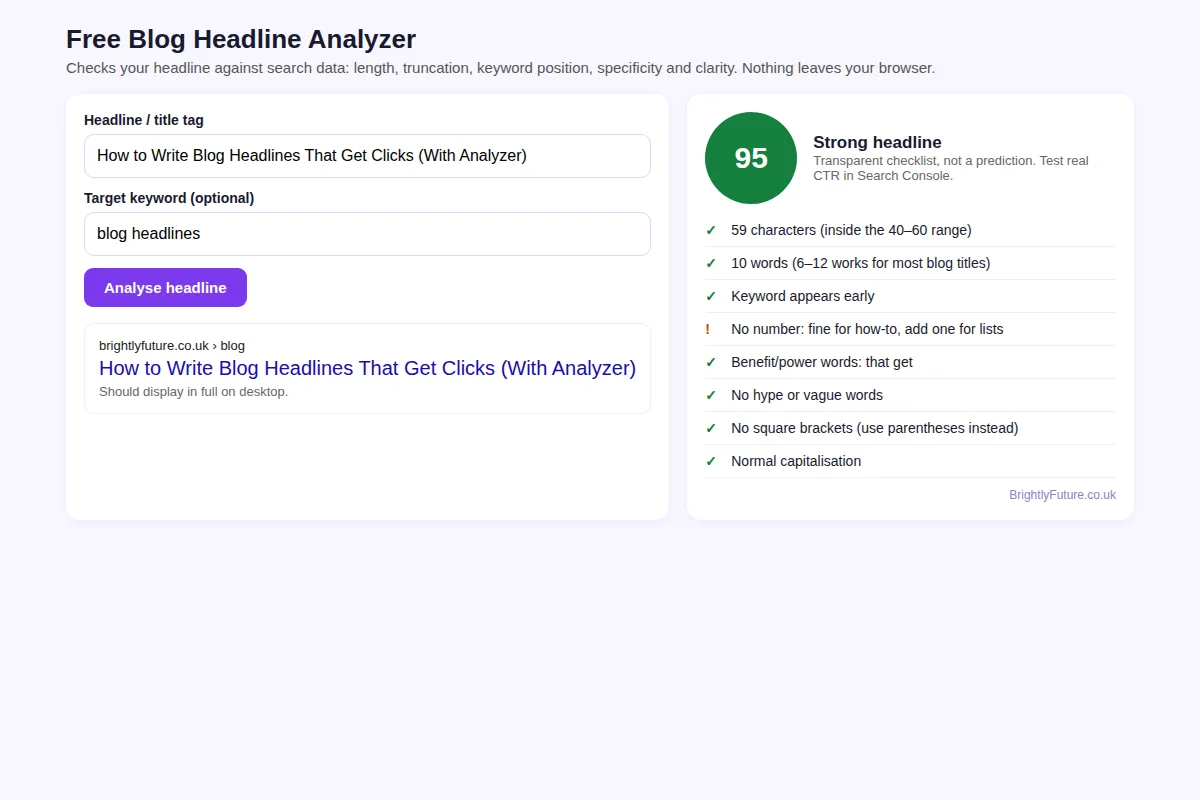
That’s why the BrightlyFuture analyzer shows a checklist, not a mystery number. Every point is tied to something with evidence behind it: length, truncation, keyword position, specificity, hype words and brackets. Here’s the difference on two headlines for this topic:

| Weak headline | Final headline | |
| Headline | Amazing Tips For Writing Headlines That Will Make Your Readers Go Crazy [Must Read] | How to Write Blog Headlines That Get Clicks (With Analyzer) |
| Characters | 83 | 59 |
| Keyword “blog headlines” | Missing | In the first 20 characters |
| Promise | Vague (“amazing tips”) | Specific (a method plus a tool) |
| Rewrite risk | High: long, with brackets | Low: under 60, parentheses |
| Analyzer score | 25 | 95 |
Use any analyzer to catch mistakes. Then let real click data decide.
Frequently Asked Questions
Should the H1 and the SEO title tag be the same?
They don’t have to match word for word. The H1 can be longer and more conversational because nothing cuts it off, while the title tag stays under 60 characters. Keep the same keyword and the same promise in both so readers land on what they clicked for.
Should I add my brand name to blog titles?
Only if your brand is known to your readers, and at the end after a dash. Otherwise it spends 15–20 characters that could hold your benefit. On blog posts, Google often adds the site name above the title link anyway.
Title case or sentence case: which is better for blog headlines?
Neither has a proven CTR advantage in Google. Pick one style and use it on every post, because a mix looks careless in a list of results. Avoid ALL CAPS, which reads as shouting and is harder to scan.
Do headlines matter for AI Overviews and ChatGPT search?
Yes, but differently. AI answers usually cite a page without showing its full title, so the headline’s job shifts to matching the question closely enough to be chosen as a source. Question-style H2s with a direct first sentence help more there than the H1 does.
Should the URL slug change when I rewrite a headline?
No. Keep the slug as it is. WordPress doesn’t change a published post’s slug when you edit the title, and changing it yourself turns the page into a new URL that needs a 301 redirect from the old one.
What if the keyword sounds awkward in a headline?
Use the natural version. Google matches close variants, so “How to Write Blog Headlines” can rank for “blog headline writing”. Never force a clunky exact-match phrase, because readers notice it before Google does.
Clear beats clever
Great blog headlines aren’t clever. They’re clear. Read what ranks, match the format, add the angle nobody else has, and keep it tight. Then trust your Search Console data over any score.
Once the headline earns the click, the article has to keep the reader. My guide on how to improve your blog readability score covers that part, and the step-by-step guide to writing a blog post with AI shows the full process from idea to publish. If you’re choosing a writing assistant, start with our best AI blog writing tools comparison.
For the bigger picture on tools, SEO and Google’s rules, start with our complete guide to AI content writing.